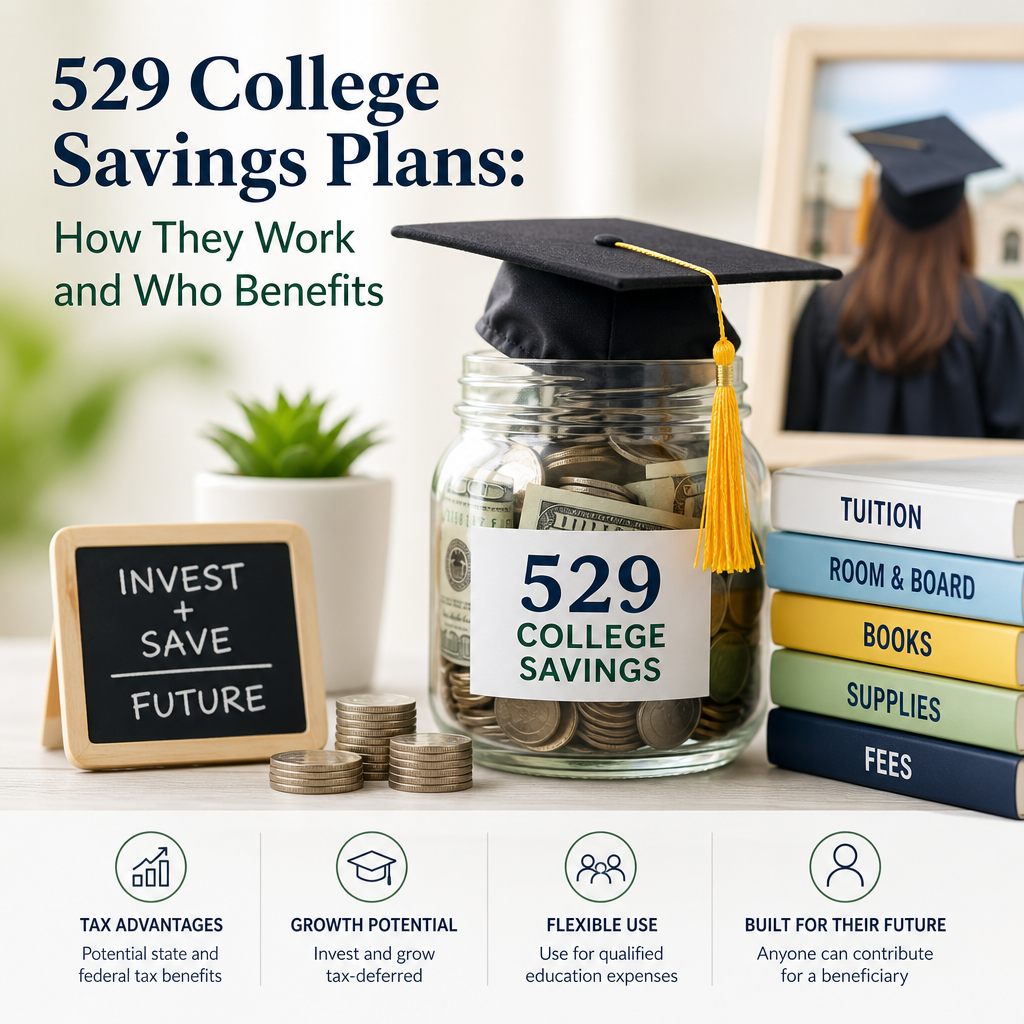
529 College Savings Plans: How They Work and Who Benefits
A 529 college savings plan offers a tax-advantaged way to invest for education, helping families prepare for future tuition and related costs with more confidence. It’s flexible enough for parents, grandparents, and other loved ones who want to make saving for school a little easier.
By: Jennifer Collins on July 30, 2026
Saving for education can feel overwhelming, especially when tuition, fees, room, board, and books keep rising. A 529 college savings plan can make that goal more manageable by giving families a tax-advantaged way to invest for future education costs. For many households, it is one of the most practical tools available for long-term education planning.
A 529 college savings plan is not just for parents with young children. Grandparents, relatives, and even friends can contribute, and the money can often be used for a wide range of qualified education expenses. Understanding how these plans work can help you decide whether a 529 account fits your family’s financial strategy.
What Is a 529 College Savings Plan?
A 529 college savings plan is a state-sponsored investment account designed to help people save for qualified education expenses. Despite the name, the account can be used for more than just college. Depending on the situation, funds may also cover costs for:
K–12 tuition in certain circumstances
Apprenticeship programs
Postsecondary education at eligible colleges, universities, and vocational schools
Unlike a regular brokerage account, the growth inside a 529 account is generally tax-deferred, and withdrawals for qualified education expenses are typically federal income tax-free. Many states also offer tax benefits for residents who contribute to their own state’s plan.
How a 529 College Savings Plan Works
The basic idea is simple:
You open an account.
You contribute money over time.
The money is invested in a portfolio you choose.
The account grows based on market performance.
You withdraw funds tax-free for qualified education costs.
Most 529 college savings plans offer age-based portfolios or static investment options. Age-based portfolios automatically become more conservative as the beneficiary gets closer to college age. This can help reduce risk over time without requiring constant management.
Key Features of a 529 College Savings Plan
A 529 college savings plan offers several features that make it appealing for education planning.
Tax Advantages
The tax treatment is one of the biggest reasons families use 529 plans. While contributions are not federally deductible, earnings grow tax-deferred. When the money is used for qualified education expenses, withdrawals are usually free from federal income tax.
Some states also allow:
State income tax deductions or credits for contributions
Tax-free withdrawals if used for qualified expenses
Additional benefits for residents investing in their home state’s plan
Because rules vary by state, it is important to review your state’s specific plan details before contributing.
High Contribution Limits
529 plans usually allow large total balances, often enough to cover several years of education costs. The exact limit depends on the state, but the cap is generally tied to estimated future education expenses. That makes these plans useful for families who want to save early and aggressively.
Flexible Account Ownership
The account owner controls the money, not the beneficiary. That means the owner decides:
How the money is invested
When withdrawals happen
Whether to change the beneficiary later
This control can be helpful if family circumstances change. For example, if one child receives scholarships and does not need the full account balance, the funds can often be transferred to another eligible family member.
Broad Range of Qualified Expenses
Many people think a 529 plan only covers tuition, but that is too narrow. Qualified education expenses may include:
Tuition and mandatory fees
Books and supplies
Computers and certain technology needs
Room and board, if the student is enrolled at least half-time
Some costs related to apprenticeship programs
Up to certain limits for K–12 tuition, depending on federal and state rules
Always confirm what qualifies before making a withdrawal, since nonqualified distributions can trigger taxes and penalties on earnings.
Who Can Benefit from a 529 College Savings Plan?
A 529 college savings plan can be a smart choice for a wide range of people, but it is especially useful for those who want to save systematically for education.
Parents of Young Children
Parents who start early often benefit the most. Even modest monthly contributions can have more time to grow, which may reduce the need for future student loans. Starting early also gives families more flexibility to adjust their goals if education costs change.
Grandparents and Relatives
Grandparents often use 529 plans as a way to support education while keeping the gift structured and intentional. In many cases, relatives can open or contribute to a plan even if they are not the parent. This can be a meaningful way to help without handing over cash that may be spent elsewhere.
Students and Young Adults
A student can also be the account owner in some cases, or a parent/relative may open the plan for them. For teens and young adults, a 529 account can still help bridge the gap between savings, scholarships, grants, and loans.
Families Considering Trade School or Apprenticeship
The value of a 529 college savings plan is not limited to traditional four-year colleges. If a student plans to attend a vocational school or qualified apprenticeship program, a 529 account may still be useful.
Anyone Seeking a Dedicated Education Fund
Even if college feels far away, a 529 plan can create financial discipline. The account keeps education savings separate from emergency funds and everyday spending, which can make it easier to stay on track.
What Can You Use 529 Funds For?
One of the most important parts of using a 529 college savings plan is knowing which expenses qualify.
Qualified Education Expenses May Include
Tuition
Required fees
Books and supplies
Computers, software, and internet access used by the beneficiary
Room and board for eligible students
Certain special needs services related to enrollment
Apprenticeship-related costs, if the program meets federal requirements
K–12 Tuition and Other Uses
Federal law allows some 529 withdrawals for K–12 tuition, subject to annual limits. Some states may treat these withdrawals differently for tax purposes, so be sure to check both federal and state rules.
In addition, recent federal law changes expanded the possible uses of 529 funds in some situations, including certain student loan repayment options and Roth IRA rollover rules under specific conditions. These features come with strict requirements, so they should be reviewed carefully before relying on them.
Pros and Cons of 529 College Savings Plans
Like any financial tool, 529 plans have strengths and limitations.
Advantages
Tax-deferred growth
Potentially tax-free withdrawals for qualified expenses
State tax deductions or credits in some cases
High contribution limits
Flexible beneficiary changes
Simple, goal-focused structure
Potential Drawbacks
Investment risk, since account value can go down
Penalties and taxes for nonqualified withdrawals on earnings
State tax benefits may be lost if you use another state’s plan
Limited investment choices compared with a full brokerage account
Rules can vary by state and change over time
For many families, the benefits outweigh the drawbacks, but only if the plan fits the education timeline and savings goals.
How to Choose a 529 College Savings Plan
If you are comparing plans, focus on more than just the tax break.
Look at Investment Options
Ask whether the plan offers:
Age-based portfolios
Index fund options
Actively managed portfolios
A mix of conservative and growth investments
A younger beneficiary may benefit from more growth-oriented investments, while someone close to college may want a more cautious approach.
Check Fees
Fees can vary widely and affect long-term performance. Review:
Enrollment fees
Administrative fees
Investment expense ratios
Underlying fund costs
Lower fees can help more of your money stay invested.
Review State Tax Benefits
If your state offers an income tax deduction or credit for contributions, that can be valuable. However, in some cases, the tax savings from your home state may offset the advantages of another plan’s lower fees. Comparing both can help you make a better decision.
Consider Plan Flexibility
A good plan should make it easy to:
Change beneficiaries
Adjust investments, within the rules
Set up automatic contributions
Use the funds for more than one educational path
Common Mistakes to Avoid
Many 529 college savings plan problems come from misunderstanding the rules.
Using the Money for Nonqualified Expenses
If you withdraw funds for something unrelated to education, the earnings portion may be subject to income tax and a penalty. Keep careful records of withdrawals and receipts.
Saving Too Conservatively Too Soon
If the money is all in cash or low-growth investments too early, it may not keep up with rising education costs. A balanced long-term investment strategy is usually more effective for younger beneficiaries.
Ignoring State Tax Rules
Not every state treats 529 plans the same way. A plan that looks attractive at first glance may not offer the best overall value after taxes and fees.
Overfunding Without a Plan
Saving for education is important, but it should not crowd out retirement savings, emergency funds, or high-interest debt repayment. A 529 plan works best as part of a broader financial plan.
Practical Examples of How a 529 Plan Can Help
A 529 college savings plan can fit different family situations.
Example 1: A Parent Starts Early
A parent opens a plan when a child is born and contributes monthly over 18 years. By the time college begins, the family may have a meaningful education fund that reduces the need for borrowing.
Example 2: Grandparents Contribute as a Gift
Instead of giving holiday cash each year, grandparents contribute to a grandchild’s 529 account. Over time, those gifts may help cover a semester’s tuition or several textbook bills.
Example 3: A Student Chooses a Trade Path
A student decides not to attend a four-year college and instead enrolls in a qualified apprenticeship. A 529 account may still help pay for eligible program costs, making the savings useful even without a traditional college route.
Frequently Asked Questions
1. Can I use a 529 college savings plan for graduate school?
Yes. In many cases, funds can be used for graduate and professional programs as long as the school is eligible and the expenses are qualified.
2. What happens if my child gets a scholarship?
You may withdraw an amount up to the scholarship value without the usual 10% federal penalty on earnings, though income tax on earnings may still apply. You may also keep the money in the account for future education or change the beneficiary to another family member.
3. Can I change the beneficiary on a 529 plan?
Yes. The account owner can usually change the beneficiary to another qualifying family member without taxes or penalties, as long as the new beneficiary is eligible under the plan rules.
4. Do 529 plans affect financial aid?
Yes, they can affect financial aid calculations, but the impact depends on who owns the account and how distributions are used. Parent-owned accounts are generally treated more favorably than accounts owned by someone else, though financial aid rules can be complex.
5. Is a 529 plan better than a savings account?
For long-term education goals, a 529 plan often offers stronger tax advantages and investment growth potential than a standard savings account. However, a savings account may be better for short-term needs or money you cannot afford to expose to market risk.
A 529 college savings plan can be one of the most effective ways to prepare for education expenses while taking advantage of valuable tax benefits. It offers flexibility, long-term growth potential, and a clear purpose that can help families stay focused on future goals. Whether you are a parent saving for a young child, a grandparent looking for a meaningful gift, or a student planning for college or vocational training, a 529 account can provide structure and momentum.
The key is to choose a plan carefully, understand the rules, and use the account as part of a broader financial strategy. Compare fees, review state tax benefits, and think about the type of education the beneficiary may pursue. Starting early often gives your contributions more time to grow, but it is never too late to learn how the plan works and decide whether it fits your needs.
If education is on your horizon, now is a good time to explore your options and make a plan that supports your family’s future.
Jennifer, M.Ed., holds a degree in Higher Education Administration, with
a focus on U.S. college financial aid, admissions policy, and student
support systems. She researches and writes about scholarships, federal
aid programs, and the college planning process to help students and
families make informed, well-supported decisions.