Federal vs. Private Student Loans: Key Differences Students Should Know
Choosing between federal vs private student loans can have a big impact on your repayment options, interest costs, and long-term financial flexibility. Here’s what every student should know before borrowing.
By: Jennifer Collins on July 30, 2026
Paying for college often means comparing federal vs. private student loans, and that decision can shape your finances for years. While both loan types can help cover tuition, housing, books, and other school expenses, they work very differently. Understanding those differences can help you borrow more strategically and avoid costly surprises later.
If you’re trying to choose the right option, the biggest question is not just how much money you can borrow. It’s also how the loan behaves after disbursement, what protections it offers, and how repayment works if life doesn’t go according to plan. That’s where the federal vs. private student loans comparison becomes especially important.
Federal vs. Private Student Loans: What They Are
Student loans generally fall into two categories:
Federal student loans are funded by the U.S. Department of Education.
Private student loans come from banks, credit unions, state agencies, and other private lenders.
The source of the loan affects nearly everything else: interest rates, eligibility, repayment options, deferment, and forgiveness opportunities. In many cases, federal loans are the first place students should look because they usually offer more borrower protections. Private loans can help fill funding gaps, but they often come with stricter terms.
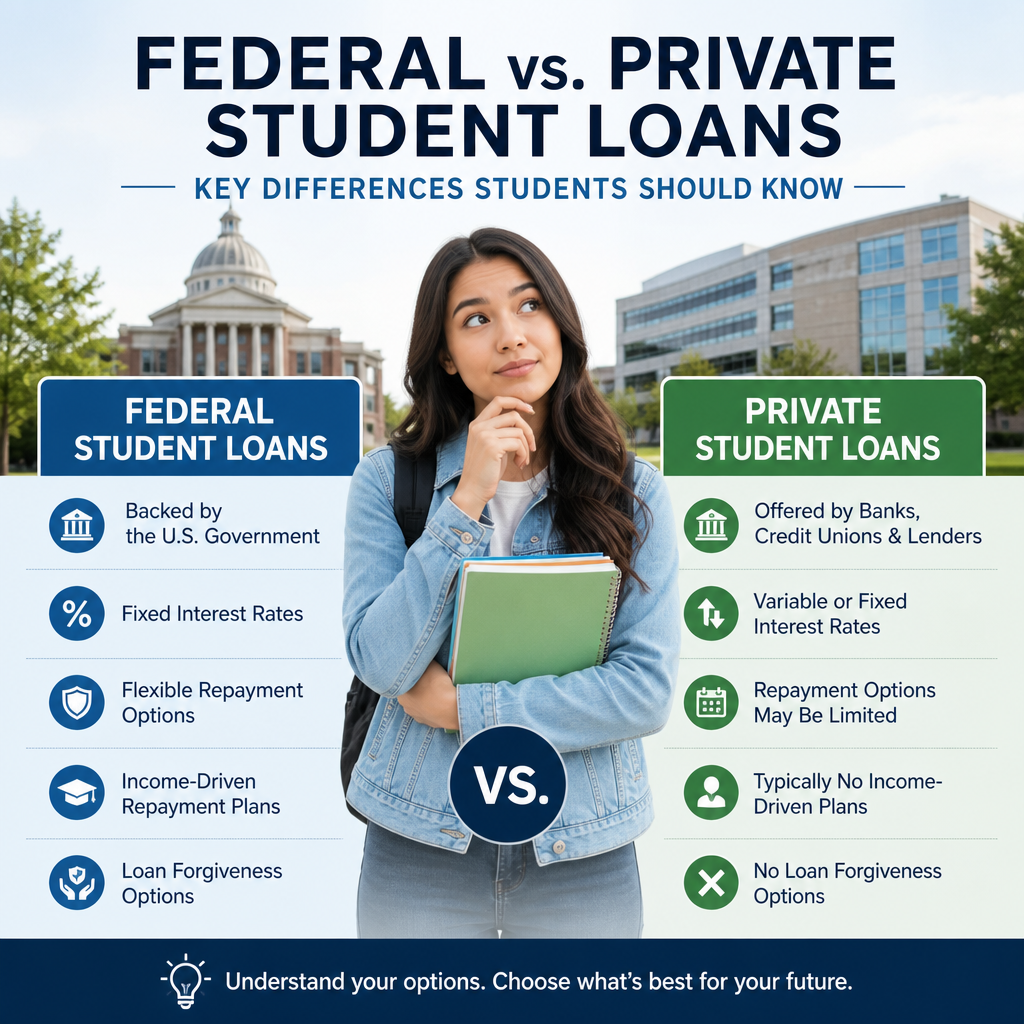
The Biggest Differences at a Glance
Before digging deeper, here are the core distinctions most students should know:
Eligibility
Federal loans are based mainly on financial need and school enrollment status.
Private loans depend heavily on credit history and income, often requiring a cosigner.
Interest rates
Federal loans typically have fixed rates set by the government.
Private loans may have fixed or variable rates, which can change over time.
Repayment flexibility
Federal loans offer several repayment plans and possible relief options.
Private loans usually have fewer repayment choices.
Borrower protections
Federal loans include deferment, forbearance, and income-driven repayment options.
Private loans offer limited hardship relief, depending on the lender.
Forgiveness
Some federal loans may qualify for forgiveness programs.
Private loans generally do not qualify for federal forgiveness.
These differences make it important to compare more than just the monthly payment.
How Federal Student Loans Work
Federal student loans are designed to make higher education more accessible. To apply, students complete the FAFSA, the Free Application for Federal Student Aid. The FAFSA helps determine eligibility for federal aid, including grants, work-study, and loans.
Common Types of Federal Student Loans
Here are the major federal loan types students may encounter:
Direct Subsidized Loans
Available to undergraduate students with financial need.
The government pays the interest while you’re in school at least half-time, during the grace period, and during deferment.
Direct Unsubsidized Loans
Available to undergraduate and graduate students.
Financial need is not required.
Interest starts accruing as soon as the loan is disbursed.
Direct PLUS Loans
Available to graduate students and parents of dependent undergraduates.
Credit requirements apply, but the standards are often less strict than private loans.
Benefits of Federal Loans
Federal student loans often stand out because they include several built-in protections:
Fixed interest rates
No credit history required for most undergraduate borrowers
Flexible repayment plans
Potential deferment and forbearance options
Access to income-driven repayment
Possible eligibility for certain forgiveness programs
For many borrowers, these benefits make federal loans the safer first choice.
How Private Student Loans Work
Private student loans are offered by lenders such as banks, credit unions, and online financial institutions. Unlike federal loans, private lenders set their own terms. That means the rate, repayment structure, and borrower requirements can vary widely from one company to another.
What Lenders Usually Look For
Private lenders typically review:
Credit score
Income
Debt-to-income ratio
Employment history
Whether a cosigner is available
Many college students have little or no credit history, so a cosigner is often required. A cosigner agrees to repay the loan if the borrower cannot. That can help the student qualify, but it also puts the cosigner’s credit at risk.
Private Loan Features to Watch
Private student loans may offer:
Fixed or variable interest rates
Shorter or longer repayment terms
Interest-only or deferred repayment while in school
Limited or no grace period
Few hardship options
Because every lender is different, it’s important to read the fine print closely before signing.
Federal vs. Private Student Loans: Interest Rates and Costs
Interest rate structure can have a major impact on how much you ultimately repay.
Federal Loans Usually Offer Predictability
Federal student loans typically come with fixed interest rates, which means your rate does not change over the life of the loan. That predictability helps with budgeting and long-term planning.
Private Loans May Cost Less or More
Private loans can sometimes advertise lower rates than federal loans, especially for borrowers with excellent credit. But those rates may be variable, meaning they can rise over time. A low introductory rate can look appealing, but it may not stay low.
When comparing loans, look at:
Interest rate type: fixed or variable
Annual Percentage Rate (APR)
Fees, including origination fees or late payment charges
Total cost over the life of the loan
A loan with a lower monthly payment is not always the cheapest loan overall.
Repayment Flexibility: A Major Federal Advantage
One of the clearest differences in the federal vs. private student loans debate is repayment flexibility. Federal loans offer multiple ways to manage payments based on income and financial circumstances.
Federal Repayment Options
Borrowers with federal loans may be able to choose from plans such as:
Standard Repayment
Graduated Repayment
Extended Repayment
Income-Driven Repayment plans
Income-driven repayment can be especially helpful for graduates entering lower-paying fields or dealing with unstable income. Payments may be adjusted based on earnings and family size.
Federal loans may also offer:
Deferment, which can pause payments in certain situations
Forbearance, which can temporarily reduce or pause payments
A grace period after leaving school before repayment begins
Private Loan Repayment Is Often Less Flexible
Private lenders may offer limited temporary relief, but they are not required to provide the same protections as federal loan programs. Some lenders may allow:
Interest-only payments while in school
A short grace period
Temporary hardship forbearance
Still, these options vary widely, and they may be harder to qualify for than federal relief programs.
Forgiveness and Loan Discharge Options
Federal loans may qualify for forgiveness or discharge in certain circumstances. This is another area where federal vs. private student loans differ significantly.
Federal Loan Forgiveness Programs
Depending on your job, repayment plan, and loan type, federal loans may be eligible for:
Public Service Loan Forgiveness
Teacher Loan Forgiveness
Income-driven repayment forgiveness
Borrowers may also qualify for discharge in cases such as:
Permanent disability
School closure
Certain types of fraud or misconduct
Private Loans Usually Do Not Offer the Same Relief
Private lenders generally do not participate in federal forgiveness programs. Some may offer limited cancellation in rare cases, but the rules are lender-specific and usually much narrower.
If loan forgiveness is part of your long-term financial plan, federal loans are generally the more favorable option.
Which Loan Type Is Easier to Get?
Federal loans are usually easier for students to access.
Federal Loans
Most undergraduate students can qualify for federal loans by completing the FAFSA and meeting basic eligibility requirements. Credit checks are usually not required for standard Direct Subsidized and Direct Unsubsidized Loans.
Private Loans
Private loans are more difficult to obtain for many students because lenders often want strong credit or a cosigner. Graduate students with established credit may have more success, but terms still vary.
If you’re a student with limited credit, federal loans are usually the more realistic starting point.
When a Private Student Loan Might Make Sense
Even though federal loans are often preferable, private student loans can sometimes be useful. For example, a private loan may make sense if:
You’ve already borrowed the maximum federal loan amount available.
You need funding for remaining college costs.
You have strong credit and can qualify for a competitive fixed rate.
You have a cosigner willing to help you access better terms.
That said, private loans should usually be considered after federal aid options are exhausted.
Practical Example
Imagine a student whose tuition and living costs exceed the amount covered by grants, scholarships, and federal loans. A private loan may help bridge the gap. But before borrowing, the student should compare:
Interest rate
Repayment term
Whether the rate is fixed or variable
Grace period
Available protections if income drops later
This kind of careful comparison can prevent expensive mistakes.
How to Choose Between Federal and Private Student Loans
Choosing the right loan starts with understanding your total cost of attendance and all available aid.
A Smart Borrowing Order
In most cases, students should consider this order:
Scholarships and grants
Work-study or part-time work
Federal student loans
Private student loans, if needed
Questions to Ask Before Borrowing
Before signing any loan agreement, ask:
Do I really need this loan, or can I reduce costs another way?
Is this a federal or private loan?
Is the interest rate fixed or variable?
What happens if I can’t make payments after graduation?
Are there fees that increase the true cost?
Can I qualify for forgiveness, deferment, or income-based repayment?
If the loan is private, it’s especially important to understand the lender’s policies on cosigners, late fees, and hardship options.
Common Mistakes Students Make
Many borrowers focus only on getting approved and overlook the long-term consequences. Avoid these common mistakes:
Borrowing more than necessary
Choosing a private loan without comparing federal options first
Ignoring variable interest rate risk
Not reading the repayment terms
Assuming all loans offer the same protections
Forgetting that cosigners share responsibility for private loans
A little research now can save a lot of stress later.
Frequently Asked Questions
1. Are federal student loans better than private student loans?
For most borrowers, federal student loans are better because they usually offer lower-risk repayment options, fixed interest rates, and more protections if financial problems arise. Private student loans can still be useful, but they typically have fewer borrower benefits.
2. Do private student loans require a credit check?
Yes, most private student loans require a credit check. If the student has limited credit history, a cosigner is often needed. The lender may also review income and existing debt before approving the loan.
3. Can I use private student loans to cover any school expense?
Usually, yes, as long as the expense is part of the school’s certified cost of attendance. That may include tuition, housing, books, supplies, and sometimes transportation or other education-related costs. The school determines how much you can borrow.
4. Can private student loans be forgiven?
Private student loans generally do not qualify for federal loan forgiveness programs. Some lenders may offer limited hardship relief or rare cancellation options, but these are not the same as government forgiveness programs and are much less common.
5. Should I take federal loans first before private loans?
In most cases, yes. Federal loans usually offer more flexibility, stronger protections, and access to repayment plans that private loans do not match. Private loans are usually best considered only after scholarships, grants, and federal aid have been used.
When comparing federal vs. private student loans, the most important thing to remember is that the lowest advertised rate is not always the best deal. Federal student loans generally offer more predictable terms, stronger borrower protections, and repayment options that can make a real difference after graduation. Private student loans can help fill financial gaps, but they often come with stricter approval requirements and fewer safeguards.
The best approach is to borrow as little as possible, start with federal aid, and review every loan carefully before signing. Look beyond the monthly payment and think about how the loan will fit into your life after school. Will you have flexibility if your income changes? Can you handle the loan if a hardship comes up? Does the loan include protections that matter to you?
Taking time to answer those questions now can protect your future budget and reduce stress later. If you’re still deciding, use official resources, compare your aid package line by line, and choose the option that gives you the best balance of affordability, flexibility, and long-term security.
Jennifer, M.Ed., holds a degree in Higher Education Administration, with
a focus on U.S. college financial aid, admissions policy, and student
support systems. She researches and writes about scholarships, federal
aid programs, and the college planning process to help students and
families make informed, well-supported decisions.