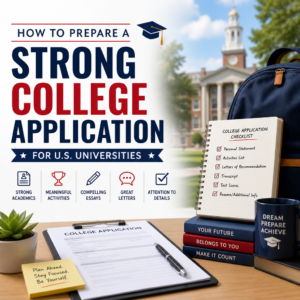
How to Prepare a Strong College Application for U.S. Universities
A strong college application is about more than grades—it’s your chance to show U.S. universities who you are, what you care about, and why you’ll be a great fit. With the right planning and a thoughtful approach, you can make every part of your college application work in your favor.
By: Jennifer Collins on July 30, 2026
Applying to U.S. universities can feel overwhelming, especially when every school seems to ask for something slightly different. The good news is that a strong college application is not about perfection. It is about presenting a clear, authentic picture of who you are, what you have done, and how you will contribute on campus. If you are wondering how to prepare a strong college application for U.S. universities, the answer starts with planning, organization, and a thoughtful approach to each part of the process.
A competitive application usually reflects strong academics, meaningful extracurricular involvement, well-written essays, and careful attention to deadlines and requirements. Just as important, it shows that you understand the schools you are applying to and why they are a good fit for your goals.
Understanding How U.S. College Applications Work
Before you start filling out forms, it helps to understand what U.S. universities typically evaluate. While every institution is different, most admissions teams look for a combination of academic preparation, personal qualities, and evidence of engagement outside the classroom.
Common Application Components
Most applications include some version of the following:
High school transcript
Standardized test scores, if required or optional
Personal statement or application essay
Supplemental essays
Letters of recommendation
Extracurricular activities list
Honors, awards, or achievements
English proficiency test scores for international students
Proof of financial support for international applicants, when needed
Some schools use the Common App, while others have their own application systems. Knowing the platform early helps you avoid surprises later.
Holistic Admissions Matter
Many U.S. universities use a holistic admissions process. That means they review more than grades alone. They want to see academic readiness, but they also care about:
Intellectual curiosity
Leadership potential
Character and maturity
Community involvement
Creativity and initiative
This is good news for students who have a strong story but may not have a perfect academic record. A thoughtful application can highlight strengths in many different ways.
Start with Academics: Build a Strong Foundation
Your academic record is one of the most important parts of your application. Colleges want evidence that you can handle their coursework and succeed in a rigorous environment.
Choose Challenging Courses
If your school offers advanced classes, such as AP, IB, honors, or dual-enrollment courses, taking a challenging schedule can strengthen your application. Admissions officers like to see that you pushed yourself academically.
However, course rigor matters more than taking every hard class available. It is better to do well in a balanced, challenging schedule than to overload yourself and let your grades suffer.
Maintain Strong Grades
A consistent GPA shows reliability and discipline. If your grades improved over time, that can also tell a positive story. Admissions officers often notice trends, not just final numbers.
If you had a difficult semester due to illness, family changes, or other challenges, address it honestly in the appropriate section of the application or through your counselor. Context matters.
Understand Test Policies
Standardized testing has become more flexible at many U.S. universities. Some schools are test-optional, while others still require SAT or ACT scores. Always check the latest admissions policy for each school.
If you decide to submit test scores, prepare strategically:
Learn each school’s requirements.
Take practice tests early.
Register with enough time to retake if needed.
Send official scores only when appropriate.
For international students, English proficiency tests such as TOEFL, IELTS, or Duolingo English Test may also be required.
Build a Meaningful Extracurricular Profile
Many students worry that they need dozens of activities to impress admissions officers. That is not the case. U.S. universities usually value depth more than quantity.
Focus on Commitment, Not Just Participation
A strong extracurricular profile shows sustained interest and genuine impact. Instead of listing many short-lived activities, emphasize the experiences where you made a difference.
Examples include:
Leading a student club
Volunteering consistently at a local nonprofit
Starting a project or small business
Participating in athletics
Conducting independent research
Performing in music, theater, or art
Helping your family or community in meaningful ways
Show Growth and Initiative
Admissions officers like to see how you developed over time. Did you move from participant to leader? Did you create something new? Did you solve a problem in your community?
For example, a student who tutors younger classmates every week and later organizes a peer study group demonstrates initiative, leadership, and service. That story is stronger than a long list of unrelated activities.
Explain the Impact
When you list activities, do not just name them. Include what you did and why it mattered. Strong applications answer questions like:
How often were you involved?
What responsibility did you have?
What changed because of your work?
What skills did you build?
Write Essays That Sound Like You
Essays are one of the best opportunities to show your personality, values, and voice. They allow admissions officers to learn things that grades and test scores cannot reveal.
Choose a Real Story
The best essays are usually grounded in specific experiences. You do not need to write about a dramatic life event. In fact, everyday moments can be powerful if they reveal something meaningful about your character.
Good essay topics often involve:
A personal challenge
A meaningful relationship
A lesson from failure
A project or passion
A shift in perspective
A moment of growth
Be Reflective, Not Just Descriptive
Many students spend too much time explaining what happened and not enough time explaining why it mattered. Your essay should show reflection.
Instead of writing only about an experience, connect it to:
What you learned
How you changed
What motivated you
How it shaped your goals
This is where many applications become memorable. Reflection helps admissions officers understand your mindset and maturity.
Avoid Common Essay Mistakes
To strengthen your college application, avoid these problems:
Repeating your résumé
Writing in a generic tone
Trying too hard to sound impressive
Using clichés
Focusing only on the outcome instead of the process
Ignoring the prompt
A strong essay sounds natural, honest, and specific. If a sentence could apply to almost any student, it probably needs revision.
Make Your Recommendation Letters Count
Letters of recommendation give universities an outside perspective on your academic and personal qualities. They can reinforce the strengths already visible in your application.
Choose the Right Recommenders
Select teachers, counselors, or mentors who know you well and can speak to your strengths with detail. A great letter usually comes from someone who has seen your work, growth, and character firsthand.
Choose people who can describe:
Your academic ability
Your work ethic
Your collaboration skills
Your leadership or initiative
Your intellectual curiosity
Ask Early and Politely
Do not wait until the last minute. Ask early so your recommenders have enough time to write thoughtful letters. When you ask, be respectful and clear about deadlines.
It also helps to provide a short packet with:
Your resume or activity list
A brief summary of your goals
A reminder of projects or experiences you shared with them
Submission instructions
Help Them Help You
A strong recommendation is easier to write when the recommender has specific examples to include. If you were especially engaged in class or completed a notable project, remind them of that work.
Tailor Each Application to the University
One of the biggest mistakes students make is sending the same generic application everywhere. U.S. universities want to know why you are applying to their school in particular.
Research Each School Carefully
Look beyond rankings. Study what each university actually offers:
Academic programs and majors
Research opportunities
Campus culture
Internship access
Student organizations
Support services
Location and size
This research helps you decide whether a school truly fits your needs.
Customize Supplemental Essays
Supplemental essays often ask why you want to attend a specific university or how you would contribute to the campus community. Use these essays to demonstrate genuine interest.
Mention concrete details such as:
A program or professor
A campus initiative
A center, lab, or studio
A tradition or student organization
A course sequence that matches your goals
Specificity shows that you took the time to learn about the institution.
Stay Organized and Respect Deadlines
A strong college application can weaken quickly if you miss deadlines or submit incomplete materials. Organization is part of your strategy.
Create an Application Timeline
Build a calendar with:
School deadlines
Test registration dates
Essay drafts and revision deadlines
Recommendation request dates
Transcript and document submission dates
Financial aid deadlines
Working backward from the earliest deadline can help you stay ahead.
Use a Tracking System
Whether you use a spreadsheet, planner, or digital task manager, keep track of:
Username and password details
Application portals
Required documents
Submission status
Financial aid forms
Interview dates
This keeps you from repeating work or overlooking a critical detail.
Review Everything Carefully
Before submitting, proofread every section. Check for:
Spelling and grammar errors
Inconsistent dates
Missing documents
Incorrect school names
Formatting issues
Overly long or incomplete responses
A polished application shows care and professionalism.
Strengthen the Rest of Your Application
Beyond the main components, there are a few additional ways to make your application more compelling.
Consider an Interview, If Offered
Some universities offer interviews as part of the process. If you have one, treat it as a chance to connect, not perform.
Prepare to discuss:
Why you are interested in the school
Your academic interests
A meaningful activity or project
What you hope to contribute
Be thoughtful, confident, and conversational.
Pay Attention to Financial Aid and Scholarships
For many families, affordability is a major part of college planning. Submit financial aid documents on time and research scholarship opportunities early.
Common forms include:
FAFSA for eligible students in the United States
CSS Profile for some private universities
Institutional scholarship applications
Outside scholarship forms
Even if you are not applying for need-based aid, some schools require financial documentation from international applicants.
Highlight Special Circumstances When Appropriate
If your application includes unusual challenges or responsibilities, explain them briefly and clearly. This is not about making excuses. It is about giving admissions officers the context they need to understand your journey.
Examples might include:
Moving schools frequently
Caring for family members
Limited access to academic resources
Working substantial hours after school
A concise explanation can add valuable perspective.
A Simple Strategy for a Strong Application
If you want a practical way to approach the process, use this step-by-step plan:
Build a list of colleges that match your goals.
Review each school’s admissions requirements.
Organize deadlines and required materials.
Strengthen your academic profile where possible.
Choose activities that reflect depth and leadership.
Draft and revise your essays carefully.
Ask for recommendation letters early.
Tailor supplemental essays to each university.
Proofread every section before submitting.
Follow up on missing documents and financial aid forms.
This process keeps you focused and prevents last-minute stress.
Frequently Asked Questions
1. What do U.S. universities look for in a college application?
U.S. universities usually look for strong academics, meaningful extracurricular involvement, thoughtful essays, and evidence of character and potential. Many schools use holistic admissions, so they evaluate the full application rather than relying on grades alone.
2. How important are extracurricular activities?
Extracurricular activities matter because they show what you care about outside the classroom. Admissions officers value commitment, leadership, and impact more than a long list of unrelated activities. A few meaningful involvements can be more persuasive than many shallow ones.
3. Do I need perfect grades to get into a good university?
No. Strong grades help, but admissions decisions are not based on grades alone. Many universities consider academic rigor, personal growth, essays, recommendations, and other factors. If your record has some weaknesses, a strong overall application can still make a difference.
4. How can I write a better college essay?
Start with a specific experience that reveals something important about you. Focus on reflection, not just events. Show how the experience changed your thinking, goals, or behavior. Revise multiple times and ask someone you trust to review it for clarity and tone.
5. When should I start preparing my college applications?
The earlier, the better. Many students begin seriously preparing during junior year of high school, but starting even earlier can help. Early planning gives you time to improve grades, build activities, research colleges, draft essays, and meet deadlines without rushing.
Preparing a strong college application for U.S. universities is really about putting together a clear, honest, and well-organized story. Admissions officers want to understand your academic preparation, your interests, your personal growth, and the ways you will contribute to their campus community. That means your application should do more than list accomplishments; it should show purpose, direction, and authenticity.
The strongest applications are built over time. They come from consistent effort in school, meaningful extracurricular involvement, carefully written essays, and attention to detail. When you research each university, tailor your materials, and stay organized through the process, you give yourself a much better chance of standing out for the right reasons.
If you are starting now, focus on the pieces you can control: strengthen your academics, choose activities that matter to you, write with honesty, and submit every part of your application carefully. A thoughtful approach can turn a stressful process into a powerful opportunity to show colleges who you are and what you are ready to become.
Jennifer, M.Ed., holds a degree in Higher Education Administration, with
a focus on U.S. college financial aid, admissions policy, and student
support systems. She researches and writes about scholarships, federal
aid programs, and the college planning process to help students and
families make informed, well-supported decisions.