How to Compare Savings Accounts and Choose the Right Option
When you compare savings accounts, don’t stop at the interest rate—fees, access, balance requirements, and transfer limits can make a big difference in how well an account fits your goals. Knowing what matters most will help you choose an option that grows your money without creating extra hassle.
By: Mary Mitchell on July 30, 2026
Choosing where to keep your money is a bigger decision than it may seem. The right account can help your cash grow, stay accessible, and support your financial goals without unnecessary fees or friction. If you’re wondering how to compare savings accounts and choose the right option, the best place to start is by looking beyond the headline interest rate and comparing the features that actually affect your day-to-day experience.
Savings accounts are not one-size-fits-all. A great fit for one person might be frustrating for another. Some people want the highest possible annual percentage yield (APY). Others care more about easy transfers, low minimum balance requirements, or the security of a local branch. By understanding what matters most, you can make a smarter choice and avoid account-opening regret later.
How to Compare Savings Accounts and Choose the Right Option
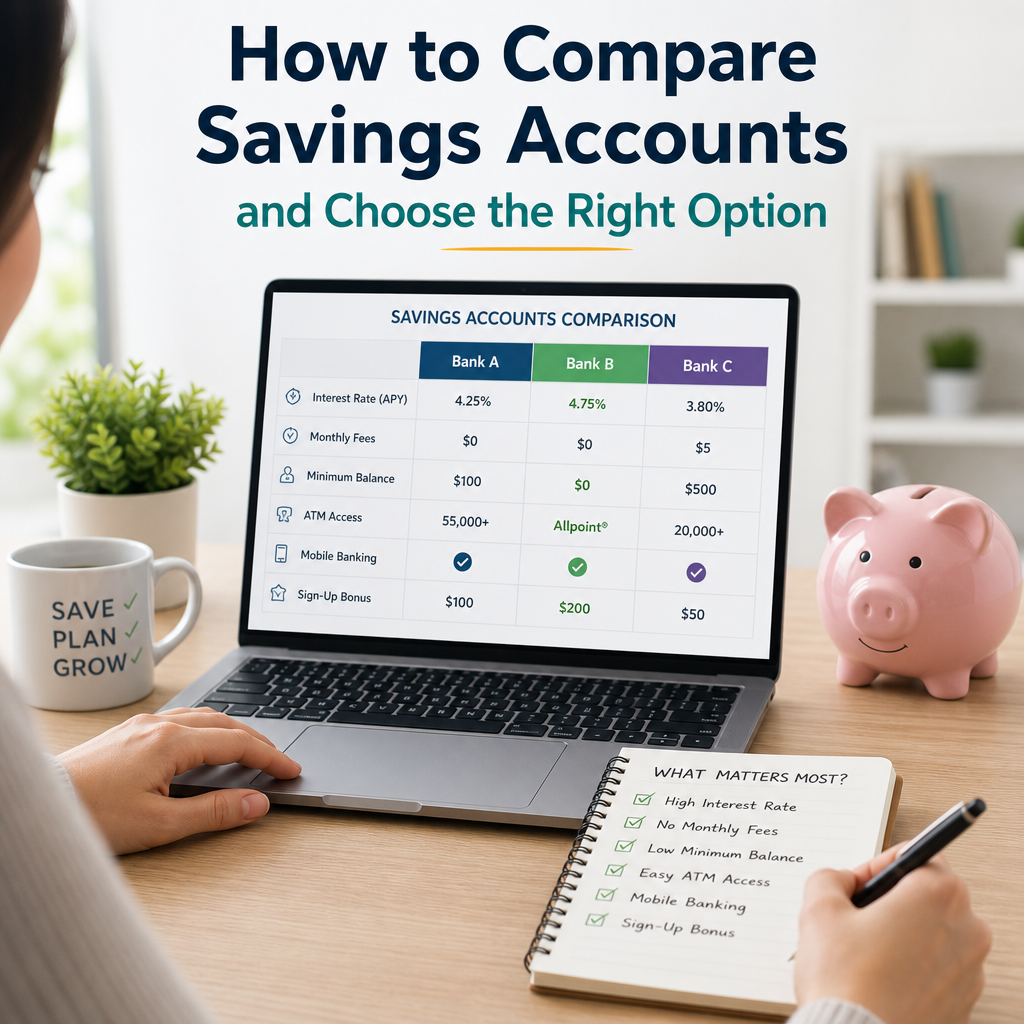
When people compare savings accounts, they often focus on interest rate alone. That’s important, but it’s only one part of the picture. A truly useful comparison should include fees, access, limits, account terms, and the overall convenience of managing your money.
Start with your savings goal
Before you compare banks or credit unions, decide what the account is for.
Common savings goals include:
Building an emergency fund
Saving for a vacation
Setting aside money for a down payment
Holding cash for short-term expenses
Creating a reserve for irregular bills
Your goal affects the type of account you may want. For example, if you need fast access to your money, a highly liquid account matters more than the absolute highest yield. If you’re building emergency savings, low fees and dependable access should be top priorities.
Compare APY, not just the interest rate
APY stands for annual percentage yield. It reflects the interest you earn over a year, including compounding. That makes it more useful than a simple interest rate when comparing savings accounts.
A few key points:
A higher APY generally means more earnings.
Compounding frequency can affect how much your balance grows.
Introductory rates may be temporary, so check whether the rate changes after a promotional period.
When comparing APY, also look at whether the rate depends on balance tiers or other conditions. Some accounts advertise attractive yields that only apply if you maintain a large balance or meet ongoing requirements.
Watch for fees that can reduce your earnings
Fees can quietly eat into whatever interest you earn. Even a strong APY may not be worth it if the account charges monthly maintenance fees or other costs.
Look carefully for:
Monthly service fees
Excessive transaction fees
Paper statement fees
Wire transfer fees
Outgoing transfer fees
ATM fees, if applicable
If an account has a monthly fee, ask whether you can avoid it by:
Keeping a minimum balance
Setting up direct deposit
Linking another account
Using electronic statements
A savings account with no monthly fee is often easier to maintain, especially if your balance will fluctuate.
Check minimum deposit and minimum balance requirements
Some accounts are easy to open, while others require a larger starting deposit or a minimum ongoing balance. These requirements can make a big difference if you’re just getting started.
Ask yourself:
Is there a minimum to open the account?
Is there a minimum balance to earn interest?
Is there a penalty if your balance drops below a certain amount?
If you’re still building your savings, a low or no minimum balance account is usually the better choice. That way, your money can grow at your own pace without stress.
Key Features to Review Before Opening a Savings Account
Once you’ve narrowed down your options by APY and fees, compare the practical features that influence how easy the account will be to use.
Access to your money
A savings account should be easy to use when you need it, but not so easy that it encourages impulse spending. Look at how you can move money in and out.
Useful access features include:
Online transfers to checking accounts
Mobile app management
ATM access, if offered
Branch access for in-person service
Customer support by phone or chat
If you prefer digital banking, a strong mobile app may matter more than having a local branch. If you like face-to-face service, a nearby branch network may be worth a slightly lower yield.
Transfer limits and withdrawal rules
Savings accounts often come with limits on certain types of withdrawals and transfers. While the specific rules can vary by institution and account type, it’s important to know how frequently you can move money and what happens if you go over a limit.
Review:
Monthly transfer limits
Processing times for transfers
Fees or restrictions on excess activity
Whether transfers are instant or delayed
If you plan to use the account for regular cash movement, make sure the rules fit your habits. A good emergency fund account should be accessible, but not difficult to leave alone.
Digital tools and user experience
A smooth digital experience can make managing savings much easier. This is especially true if you like setting goals, scheduling automatic transfers, or checking balances from your phone.
Helpful features may include:
Automatic transfers
Savings goals or “buckets”
Spending alerts
Mobile check deposit
Account linking across banks
Budgeting tools
These tools don’t add direct earnings, but they can make it easier to stay consistent and reach your goals faster.
Customer service and reputation
A savings account is a financial relationship. If something goes wrong, you want responsive support and clear communication.
Consider:
Customer service hours
Live chat or phone support
Online reviews from reliable sources
Complaint handling process
Availability of local branch help, if relevant
Look for a provider that explains account terms clearly. If the fine print is confusing before you open the account, it may be even more frustrating later.
Different Types of Savings Accounts to Consider
Not all savings accounts work the same way. Understanding the main categories can help you choose the right option for your financial goals.
Traditional savings accounts
These accounts are typically offered by banks and credit unions with branches. They often provide basic savings features, easy transfers, and face-to-face customer service.
Best for:
People who value convenience and branch access
Those who want a simple place to store cash
Customers who prefer an established institution
Traditional savings accounts may offer lower APYs than online-only options, but they can still be a good fit if service and access matter more to you.
High-yield savings accounts
High-yield savings accounts are designed to offer stronger APYs than many standard accounts, often through online banks or institutions with lower overhead. They can be appealing if you want your emergency fund or short-term savings to earn more.
Best for:
Savers focused on maximizing interest
People comfortable banking online
Those who don’t need frequent in-person service
Before opening one, compare all the usual details: fees, transfer rules, customer support, and account access. A strong rate is helpful, but it shouldn’t come with hidden drawbacks.
Money market accounts
Money market accounts can combine features of savings and checking accounts. Some offer check-writing or debit card access, though that depends on the institution.
Best for:
Savers who want more flexibility
People keeping larger balances
Those who want a mix of yield and access
Money market accounts may require higher minimum balances, so they’re not always the best fit for smaller savers.
Specialized savings accounts
Some banks offer accounts with specific purposes, such as:
Holiday savings
Kids’ savings
Goal-based subaccounts
Relationship-based savings bundles
These can be useful if the structure helps you stay organized. Just make sure the features are genuinely helpful and not just marketing.
A Simple Process for Comparing Savings Accounts
If the options feel overwhelming, use a step-by-step approach. This keeps your decision practical and avoids getting distracted by flashy offers.
1. Identify your priorities
Rank what matters most to you:
Highest APY
No monthly fees
Low minimum deposit
Easy mobile access
Branch convenience
Strong customer support
Knowing your top priorities helps you filter options quickly.
2. Build a shortlist
Compare three to five accounts from banks or credit unions you trust. Use the official product pages to gather details on fees, APY, balance requirements, and access.
3. Read the fine print
Pay attention to account disclosures and fee schedules. This is where you’ll find rules about:
Rate changes
Balance requirements
Transfer limits
Account closure fees
Paper statement charges
4. Estimate your likely earnings
If you want to understand the real value of an account, estimate how much interest you might earn based on your balance. You don’t need a complicated spreadsheet—just a rough comparison can show whether a rate difference is worth it.
5. Consider convenience over hype
The “best” savings account is the one you’ll actually use well. A slightly lower APY may be acceptable if the account is easier to manage, has fewer fees, or helps you save consistently.
Practical Example: Choosing Between Two Accounts
Imagine you’re comparing two savings accounts:
Account A offers a slightly higher APY, but it charges a monthly fee unless you maintain a large minimum balance.
Account B offers a somewhat lower APY, but it has no monthly fee, no minimum balance requirement, and a strong mobile app.
If you’re saving $500 to $2,000, Account B may be the better option. The fee-free structure could leave you with more usable money, and the easy setup may help you build your savings faster.
On the other hand, if you plan to keep a much larger balance and meet the fee waiver requirements, Account A might make more sense. The key is to compare the full picture, not just the advertised rate.
Common Mistakes to Avoid
It’s easy to rush this decision and focus on the wrong details. Avoid these mistakes when comparing savings accounts:
Choosing only by APY
Ignoring monthly fees
Missing minimum balance requirements
Overlooking transfer restrictions
Forgetting to check customer service quality
Opening an account without reading the disclosures
A little extra time upfront can save you frustration later.
Frequently Asked Questions
1. What is the most important factor when comparing savings accounts?
The most important factor depends on your goal. For many people, the best place to start is APY, but fees, minimum balance requirements, and access to your money are just as important. If an account has a high yield but charges monthly fees, it may not be the best value.
2. Is a high-yield savings account always the best choice?
Not always. High-yield savings accounts can offer better returns, but they may come with online-only service, transfer delays, or balance requirements. If you value branch access or need very easy in-person support, a traditional savings account may be a better fit.
3. Should I keep my emergency fund in a savings account?
Many people do keep emergency funds in a savings account because the money stays accessible and separate from everyday spending. A high-yield savings account is often a popular choice because it combines liquidity with the potential to earn more interest than a standard account.
4. How many savings accounts should I have?
There’s no single right number. Some people use one account for simplicity, while others keep separate accounts for emergency savings, travel, and short-term goals. If multiple accounts help you stay organized and avoid mixing funds, that can be a smart approach.
5. Can I lose money in a savings account?
Savings accounts are designed to protect your principal, but you can still lose value indirectly to fees or inflation. That’s why it’s important to choose an account with low costs and a competitive APY. Also, make sure the institution is insured through the appropriate federal program.
Comparing savings accounts is about more than finding the highest advertised rate. To choose the right option, look at the full package: APY, fees, minimum balances, access to your money, digital tools, and customer service. The best account for you is the one that supports your goals without creating unnecessary costs or hassles.
If you’re building an emergency fund, saving for a short-term goal, or simply trying to make your cash work harder, a thoughtful comparison can help you keep more of what you earn. Start with your priorities, read the disclosures, and choose an account that fits your habits and comfort level. A savings account should make it easier to save, not harder.
Taking a few minutes to compare your options now can lead to better financial habits and more confidence later. Whether you choose a traditional savings account, a high-yield savings account, or a money market account, the right decision will help your money stay safe, accessible, and productive.
Mary S, CFP®, is a Certified Financial Planner with over 12 years of experience in personal finance, retirement planning, and wealth management. She writes educational content that helps readers understand financial concepts and make informed decisions based on reliable information.