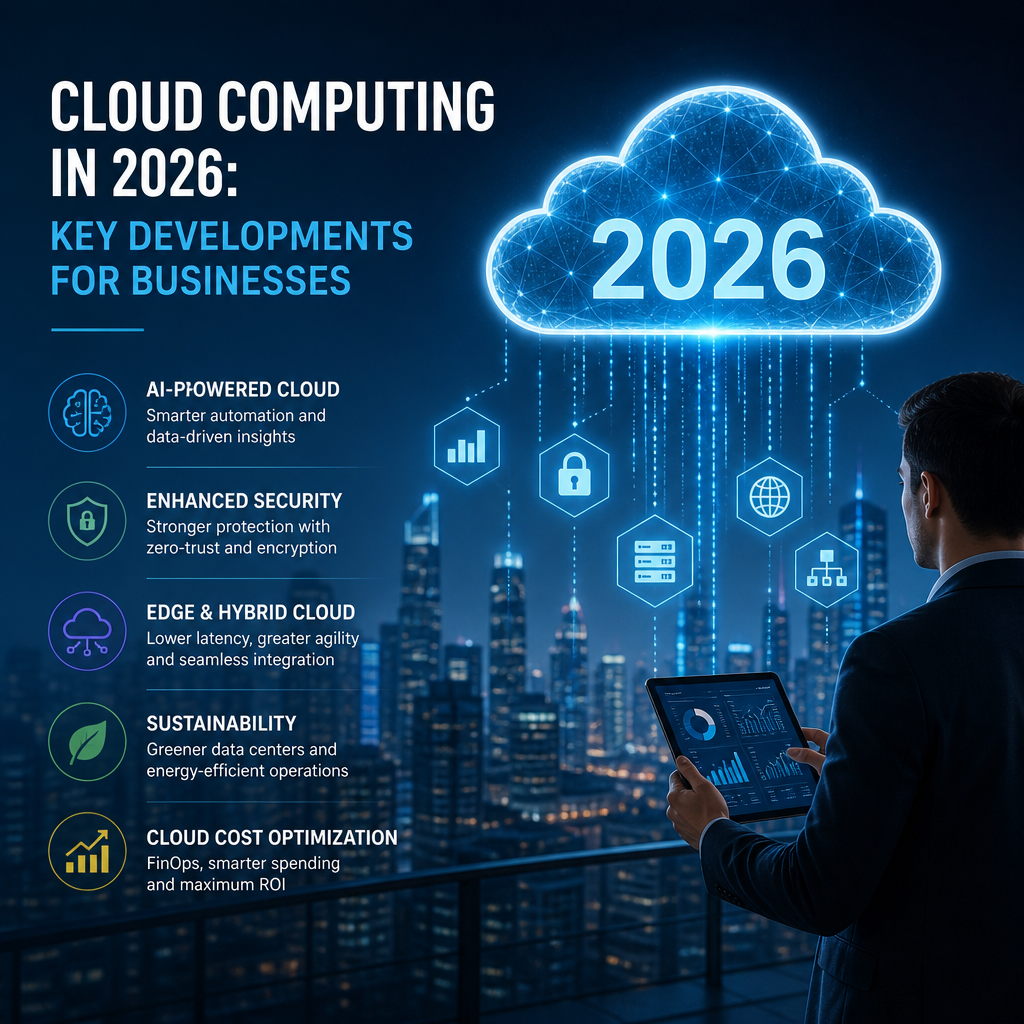
Cloud Computing in 2026: Key Developments for Businesses
Cloud computing in 2026 is moving beyond basic infrastructure and becoming a core driver of business agility, security, and innovation. From AI-native services to smarter hybrid strategies, the latest cloud trends will shape how companies compete, scale, and manage risk.
By: Peter on July 30, 2026
Cloud computing in 2026 is no longer just about renting servers or backing up files offsite. It has become the backbone of modern business operations, shaping how organizations build software, protect data, automate workflows, and scale globally. Companies that want to stay competitive need to understand where cloud computing is headed and how those changes may affect cost, security, compliance, and innovation.
From AI-driven cloud services to stricter security expectations and more flexible hybrid architectures, cloud computing in 2026 is evolving quickly. The businesses that pay attention now will be better positioned to make smarter technology decisions, avoid unnecessary risk, and unlock new efficiency gains.
Cloud Computing in 2026: Why It Matters More Than Ever
Cloud computing has matured into a strategic business layer, not just an IT utility. In 2026, cloud platforms are increasingly tied to revenue generation, customer experience, supply chain resilience, and product development.
Organizations are using cloud environments to:
Launch applications faster
Support remote and distributed teams
Store and analyze large volumes of data
Use AI and machine learning tools without major infrastructure investment
Improve disaster recovery and business continuity
The real shift is that cloud adoption is no longer about “moving to the cloud.” It is about using the cloud intelligently. Businesses are becoming more selective about which workloads belong in public cloud, private cloud, or hybrid environments. They are also asking harder questions about security, vendor lock-in, compliance, and long-term cost control.
Key Cloud Computing in 2026 Developments Businesses Should Watch
1. AI-Native Cloud Services Will Become Standard
Artificial intelligence is now deeply embedded in cloud computing in 2026. Major cloud providers are offering AI-native services that help companies build, deploy, and manage intelligent applications faster.
This includes:
Managed machine learning platforms
Generative AI APIs
AI-assisted development tools
Automated monitoring and optimization
Intelligent search, forecasting, and analytics features
For businesses, this means faster experimentation and less infrastructure complexity. A small marketing team, for example, may use cloud-based AI tools to generate campaign insights, while a healthcare startup might use secure cloud AI services to help analyze records or automate administrative tasks.
However, AI in the cloud also introduces new responsibilities. Companies should evaluate:
Data privacy and retention policies
Model transparency and explainability
Bias and accuracy risks
Where data is processed and stored
The business advantage is clear, but governance matters just as much as innovation.
2. Hybrid and Multi-Cloud Architectures Are Becoming the Default
One of the biggest trends in cloud computing in 2026 is the move away from a single-cloud strategy. Many businesses are embracing hybrid cloud and multi-cloud architectures to gain more flexibility.
A hybrid cloud approach combines on-premises systems with public cloud services. Multi-cloud means using services from more than one cloud provider. Both models can help businesses:
Improve resilience
Avoid overdependence on one vendor
Place workloads where they perform best
Meet regulatory or data residency requirements
For example, a financial services company might keep sensitive transaction data in a private environment while using public cloud tools for analytics and collaboration. A retailer may use one cloud provider for e-commerce and another for data warehousing.
The challenge is complexity. Managing multiple environments requires stronger governance, better observability, and a clear architecture plan. Businesses should not adopt multi-cloud just because it sounds strategic. They should do it when there is a real operational or business reason.
3. Cloud Security Will Move Toward Zero Trust
Security remains one of the most important issues in cloud computing in 2026. As threats become more sophisticated, businesses are increasingly adopting zero trust principles.
Zero trust assumes that no user, device, or application should be trusted automatically, even inside the network. Instead, access is continuously verified based on context and risk.
This approach often includes:
Strong identity and access management
Multi-factor authentication
Least-privilege access controls
Continuous device and user verification
Microsegmentation of networks and workloads
Cloud environments are especially well suited for zero trust because they are built around distributed access and identity-based control. But implementing zero trust effectively requires discipline. Businesses need clear policies, regular audits, and employee training.
In 2026, companies should expect security teams to focus more on identity, behavior monitoring, and automation than on perimeter defenses alone.
4. FinOps Will Be Essential for Cloud Cost Control
Cloud adoption can create financial efficiency, but only if companies manage usage carefully. In cloud computing in 2026, cost discipline is becoming a core business function through FinOps, or cloud financial operations.
FinOps brings finance, engineering, and operations teams together to understand and optimize cloud spending. Instead of treating cloud costs as a fixed IT bill, businesses use FinOps to make cloud usage more visible and accountable.
Common FinOps practices include:
Tagging resources by team, project, or environment
Setting budgets and alerts
Right-sizing compute and storage
Turning off unused resources
Reviewing reserved capacity or committed-use discounts
Tracking cost per application or customer
A practical example: a software company may discover that development environments are running overnight when no one is using them. By automating shutdowns, the company reduces waste without affecting productivity.
In 2026, cloud cost management is not just about saving money. It is about ensuring cloud investments align with business value.
5. Edge Computing Will Expand Cloud Capabilities
Not all data can or should travel back to a central cloud region. That is why edge computing is becoming increasingly important in cloud computing in 2026.
Edge computing processes data closer to where it is generated, such as in factories, retail locations, vehicles, or smart devices. This reduces latency and can improve reliability for time-sensitive applications.
Businesses are using edge and cloud together for:
Industrial IoT monitoring
Real-time retail analytics
Smart logistics
Connected healthcare devices
Automated quality control in manufacturing
For instance, a manufacturer may use edge systems to detect equipment anomalies immediately, then send summarized data to the cloud for deeper analysis. This approach improves speed while reducing bandwidth strain.
As more industries rely on connected devices, cloud providers are expanding edge integration. Businesses should watch how their cloud strategy can support both centralized intelligence and local responsiveness.
6. Data Governance and Compliance Will Get Stricter
The more data businesses place in the cloud, the more important governance becomes. In 2026, cloud computing is tightly connected to compliance, auditability, and data stewardship.
Organizations need to know:
Where data resides
Who can access it
How long it is retained
Whether it is encrypted at rest and in transit
How it is classified and protected
This is especially important for regulated sectors such as healthcare, finance, education, and government contracting. But even non-regulated businesses must prepare for stronger customer expectations and evolving privacy laws.
Good cloud governance includes:
Data classification policies
Retention and deletion rules
Encryption standards
Access reviews
Vendor risk assessments
Audit logs and monitoring
The cloud makes compliance easier in some ways, but only when businesses configure it correctly. Shared responsibility still applies, and companies remain responsible for how they use cloud services.
7. Platform Engineering Will Improve Developer Productivity
As cloud environments become more complex, many organizations are investing in platform engineering. This approach creates internal developer platforms that simplify deployment, standardize tools, and reduce friction for engineering teams.
Instead of forcing developers to assemble cloud resources manually, platform engineering provides a streamlined experience with built-in guardrails.
Benefits include:
Faster application delivery
More consistent security controls
Reduced operational overhead
Easier onboarding for development teams
Better alignment between engineering and operations
A common example is a company offering pre-approved deployment templates that include monitoring, security policies, and infrastructure settings. Developers move faster without bypassing governance.
In cloud computing in 2026, platform engineering is becoming a key enabler of scale. It helps businesses balance innovation with reliability.
8. Sustainability and Energy Efficiency Will Influence Cloud Decisions
Sustainability is becoming a practical technology consideration, not just a branding topic. Cloud providers are under pressure to improve energy efficiency and reduce environmental impact, and businesses are increasingly factoring that into buying decisions.
Companies may now consider:
Carbon-conscious workload placement
Energy-efficient infrastructure options
Data center region selection
Resource optimization to reduce waste
Vendor sustainability reporting
This matters because cloud usage at scale consumes energy, and organizations want more visibility into the environmental footprint of their digital operations. In some industries, sustainability reporting may also influence procurement and investor expectations.
Businesses can support this trend by reducing idle resources, optimizing storage policies, and choosing cloud services that match actual workload needs.
9. Cloud Resilience and Disaster Recovery Will Stay a Top Priority
The business value of cloud is not just speed. It is also continuity. In 2026, organizations are paying closer attention to cloud resilience because downtime can affect revenue, reputation, and customer trust.
Modern disaster recovery strategies often include:
Multi-region deployments
Automated backups
Immutable storage
Recovery testing
Failover planning
Chaos engineering and resilience testing
A business that stores critical systems in the cloud should not assume resilience comes automatically. It must design for failure, test its recovery plans, and understand how quickly it can restore operations after an outage.
For customer-facing industries like e-commerce, logistics, and financial services, resilience is a business necessity, not an IT luxury.
How Businesses Should Prepare for Cloud Computing in 2026
Watching trends is useful, but action matters more. To prepare for cloud computing in 2026, businesses should focus on practical steps that build flexibility and reduce risk.
Review Your Current Cloud Architecture
Start by assessing what you already have in place. Look at:
Which workloads are in the cloud
Which applications depend on cloud services
Whether your architecture supports future growth
Where security or compliance gaps exist
This review can reveal unnecessary complexity or opportunities to consolidate.
Strengthen Cloud Governance
Cloud governance should define clear rules for access, data handling, cost management, and service approval. Without governance, cloud sprawl can quickly become a problem.
Useful governance controls include:
Standardized naming and tagging
Access approval workflows
Security baselines
Budget thresholds
Regular audits
Invest in Skills and Training
Cloud computing in 2026 requires more than technical tools. Teams need training in security, data governance, automation, and cost optimization. Business leaders should support ongoing education for both IT and non-technical staff.
Align Cloud Strategy With Business Goals
Every cloud investment should connect to a measurable business outcome. Whether the goal is faster product launches, better customer experience, or stronger resilience, cloud decisions should support that objective.
Common Mistakes Businesses Should Avoid
Even with strong cloud platforms, companies can still make costly mistakes. Watch out for these common pitfalls:
Migrating workloads without a clear business case
Ignoring cloud cost visibility until bills rise sharply
Using weak identity and access controls
Overlooking compliance requirements
Building too much custom complexity too early
Failing to test disaster recovery plans
Cloud computing in 2026 rewards thoughtful execution. Businesses that rush into new services without planning often create more problems than they solve.
Frequently Asked Questions
What is the biggest trend in cloud computing in 2026?
One of the biggest trends is the rise of AI-native cloud services. Businesses are using cloud platforms to access generative AI, automation, and advanced analytics without building everything from scratch. At the same time, hybrid and multi-cloud strategies are becoming more common as companies seek flexibility and resilience.
Is multi-cloud better than single-cloud?
Not always. Multi-cloud can reduce vendor dependence and improve flexibility, but it also adds complexity and management overhead. A single-cloud strategy may be more efficient for businesses with simpler needs. The right choice depends on workload requirements, compliance obligations, budget, and internal expertise.
How can businesses reduce cloud costs in 2026?
Businesses can reduce cloud costs by tracking usage, shutting down idle resources, right-sizing instances, using reserved capacity when appropriate, and applying FinOps practices. Cost reduction works best when finance and technical teams collaborate regularly rather than treating cloud spending as an afterthought.
Why is zero trust important for cloud security?
Zero trust is important because cloud environments are highly distributed and often accessed from many devices and locations. Instead of trusting users or devices by default, zero trust verifies access continuously. This helps reduce the risk of unauthorized access and limits the impact of compromised credentials.
What should a business prioritize when updating its cloud strategy?
A business should prioritize security, governance, cost control, and alignment with business goals. It should also assess whether its current architecture supports scalability, resilience, and compliance. The best cloud strategy is not simply the most advanced one; it is the one that creates measurable business value.
Cloud computing in 2026 is shaping up to be more strategic, more intelligent, and more demanding than ever before. Businesses that succeed will not just adopt cloud tools; they will build clear strategies around AI integration, hybrid flexibility, zero trust security, FinOps, governance, and resilience. These developments are not abstract technology trends. They directly affect how companies operate, compete, and serve customers.
The key takeaway is simple: cloud success now depends on discipline as much as innovation. Organizations that understand their workloads, control spending, protect data, and align cloud decisions with business goals will be better prepared for the next wave of change. Whether you are modernizing an existing environment or planning a new initiative, now is the time to assess your cloud strategy and strengthen it for what comes next.
Peter B holds a degree in Journalism and has 5 years of experience covering U.S. economic policy, labor markets, and financial news. He writes data-driven news content on topics like inflation, interest rates, and employment trends.