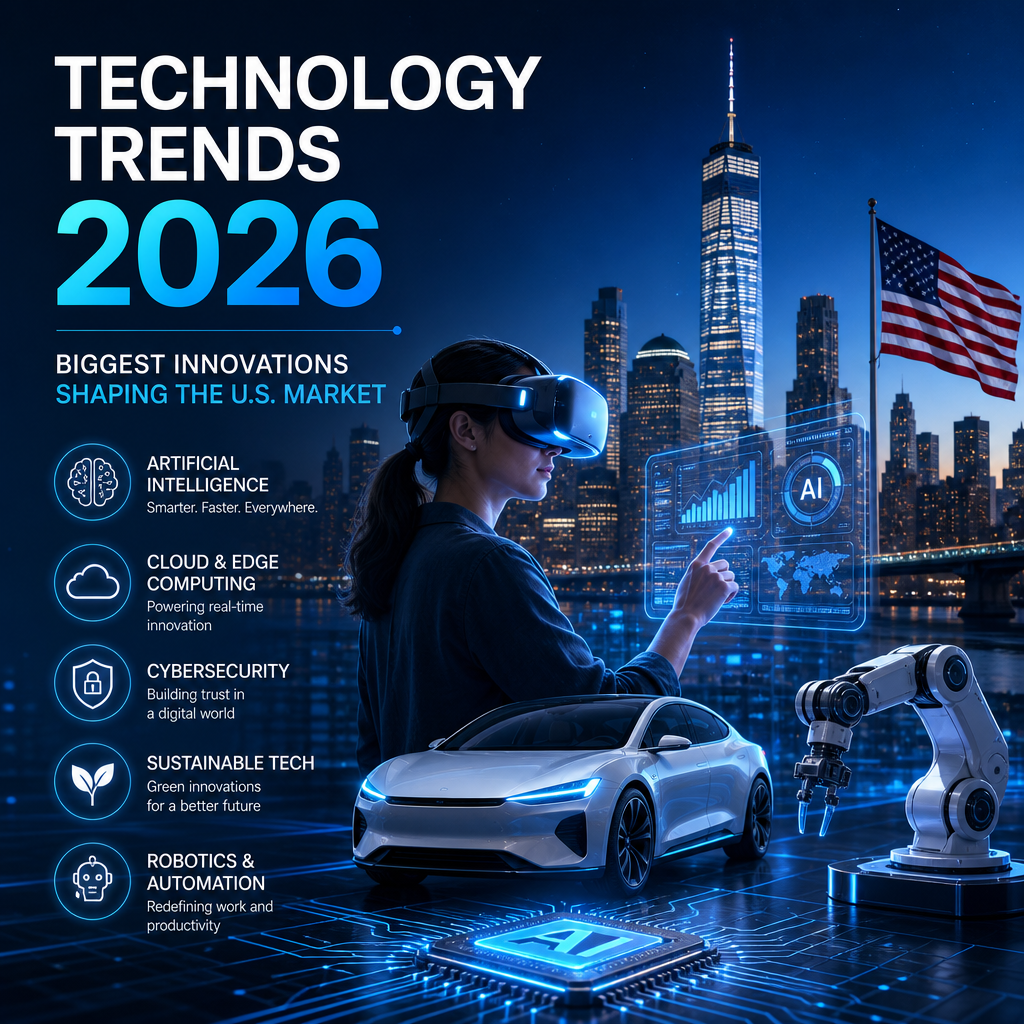
Technology Trends 2026: Biggest Innovations Shaping the U.S. Market
Technology trends 2026 are transforming the U.S. market from the inside out, with practical innovations like AI-powered workflows, smarter security, and connected systems moving into everyday business operations. As these tools become more accessible, companies of all sizes have a bigger opportunity to boost efficiency, reduce risk, and stay competitive.
By: Peter on July 30, 2026
Technology trends in 2026 are reshaping how American companies build products, serve customers, and compete. From AI-powered workflows to more secure digital infrastructure, the pace of change is accelerating across nearly every industry. Businesses that understand these shifts can make smarter investments, reduce risk, and stay ahead of competitors.
What makes technology trends 2026 especially important is that they are no longer limited to experimental labs or tech giants. Many of the biggest innovations shaping the U.S. market are now practical, scalable, and already being adopted by mid-size businesses, startups, healthcare systems, retailers, manufacturers, and public sector organizations.
In this article, we’ll break down the major trends to watch, why they matter, and how they may influence the U.S. economy and everyday business operations.
Why Technology Trends 2026 Matter for the U.S. Market
The U.S. market has always been quick to adopt technologies that improve speed, efficiency, and customer experience. In 2026, that momentum continues, but with a stronger focus on:
automation that cuts manual work
AI tools that support better decisions
cybersecurity that protects complex digital systems
connected devices that collect real-time data
software that helps teams work across locations
Businesses are no longer asking whether they should adopt new technology. They are asking how fast they can do it without creating risk or overwhelming staff.
The shift from experimentation to execution
A few years ago, many companies tested emerging tools in isolated pilots. In 2026, the focus has moved toward execution. Leaders want technologies that deliver measurable value, integrate with existing systems, and scale across departments.
That shift is driving more demand for practical innovations rather than flashy concepts.
AI-Powered Business Operations Are Becoming the New Standard
Artificial intelligence remains one of the most influential technology trends 2026 has to offer. But the conversation has changed. Instead of asking whether AI can help, businesses are now asking where it should be applied first.
AI is moving deeper into everyday workflows
In 2026, AI is increasingly embedded into tools people already use for:
writing and editing content
summarizing meetings and documents
analyzing customer feedback
forecasting demand
automating repetitive support tasks
flagging unusual activity in financial or security systems
This kind of practical AI helps employees work faster without replacing human judgment.
Real-world use cases in the U.S. market
Businesses across the country are using AI in targeted ways:
Retail: product recommendations, inventory forecasting, customer service chat tools
Professional services: contract review, research support, workflow automation
The biggest benefit is not simply efficiency. It is better decision-making with less time spent on routine work.
What businesses should watch
AI adoption works best when companies:
define the exact problem they want to solve
verify data quality before automating decisions
keep humans involved in review and oversight
train staff to use AI responsibly
monitor outputs for accuracy and bias
Companies that skip these steps can create more problems than they solve.
Cybersecurity Innovation Is a Top Priority
As digital systems become more connected, cybersecurity becomes even more critical. In 2026, the threat landscape continues to evolve, and organizations need stronger defenses across cloud systems, mobile devices, endpoints, and third-party platforms.
Security is now built into technology planning
One major change in technology trends 2026 is the move from reactive security to proactive security. Instead of treating cybersecurity as a separate function, many organizations are building it into every technology decision.
This includes:
zero trust architecture
identity and access management
continuous monitoring
secure software development practices
automated threat detection
stronger cloud configuration controls
Why this matters for businesses of all sizes
Small and mid-sized businesses are often more vulnerable than large enterprises because they may not have dedicated security teams. At the same time, they increasingly rely on cloud platforms, vendor integrations, and remote work tools.
That creates more entry points for attackers.
A practical cybersecurity strategy in 2026 usually focuses on:
multi-factor authentication
staff training on phishing and social engineering
regular patching and updates
backup and recovery planning
vendor risk management
least-privilege access controls
These basics may not sound exciting, but they are essential.
Edge Computing and Real-Time Data Are Expanding
Another major technology trends 2026 development is the growing use of edge computing. Rather than sending all data to a centralized cloud server, edge computing processes information closer to where it is generated.
Why edge computing is gaining traction
This approach matters for applications that need low latency, fast response times, or local processing. It is especially useful in:
manufacturing equipment monitoring
logistics and fleet tracking
smart retail environments
healthcare devices
connected industrial systems
security cameras and sensors
Practical example
Imagine a manufacturing facility that uses sensors to detect equipment vibration. With edge computing, the system can analyze data on-site and identify possible failures quickly. That can reduce downtime and help maintenance teams act before a problem becomes costly.
Why U.S. industries care
American companies increasingly depend on real-time data to make decisions faster. Edge computing supports that goal by reducing delays and improving reliability.
It also helps organizations manage bandwidth and process sensitive data locally when needed, which can support privacy and compliance goals.
Smart Automation Is Reshaping the Workforce
Automation is not new, but in 2026 it is becoming more advanced, more accessible, and more integrated with AI. This combination is changing how teams work across the U.S. market.
Automation is moving beyond repetitive tasks
Earlier forms of automation handled simple, rules-based jobs. Today, intelligent automation can manage more complex workflows, including:
invoice processing
customer intake
scheduling
report generation
data entry and validation
internal request routing
The real impact on employees
The most successful organizations are using automation to remove low-value tasks, not people. This allows staff to focus on work that requires creativity, judgment, and relationship-building.
For example, a customer service team might use automation to:
classify incoming requests
suggest responses
route urgent cases
summarize interaction history
That does not eliminate the role of human support. It improves speed and consistency.
Why adoption depends on trust
Employees are more likely to embrace automation when leaders explain:
what the tool does
what it does not do
how outputs are reviewed
how jobs and responsibilities may change
Clear communication matters as much as the technology itself.
Cloud Platforms Are Getting Smarter and More Specialized
Cloud computing remains foundational, but in 2026 the market is seeing more specialized cloud services, better integration options, and greater demand for flexibility.
Hybrid and multi-cloud strategies are common
Many U.S. companies are using a mix of cloud environments rather than relying on a single vendor. This approach can help with:
resilience
cost control
compliance
performance optimization
vendor risk reduction
Industry-specific cloud tools are growing
Instead of generic systems, businesses are choosing cloud platforms tailored to their sector. Examples include:
healthcare systems with compliance-ready workflows
financial platforms with stronger audit features
retail systems with omnichannel inventory visibility
manufacturing systems with asset tracking and analytics
What to evaluate before moving more workloads to the cloud
A smart cloud strategy should consider:
security requirements
data residency and compliance issues
integration with legacy systems
cost predictability
vendor support and lock-in risks
Cloud adoption is no longer just about storage. It is about creating a flexible digital foundation for long-term growth.
The Rise of Connected Devices and Industrial IoT
Connected devices and the Industrial Internet of Things continue to expand across the U.S. market. These technologies collect and share data from machines, buildings, vehicles, and consumer products.
Where connected systems are making the biggest difference
Industries using IoT effectively include:
logistics and transportation
energy and utilities
agriculture
manufacturing
commercial real estate
healthcare
Why IoT is more useful in 2026
IoT systems are becoming more capable because sensors are cheaper, connectivity is better, and analytics tools are more advanced. That means businesses can now turn device data into actionable insights more easily.
For example:
a logistics company can track vehicle health and route efficiency
a building manager can monitor energy use and occupancy patterns
a hospital can track equipment location and usage
a farm can monitor soil conditions and irrigation needs
The challenge: managing complexity
Connected device ecosystems create new security and maintenance challenges. Organizations need to manage firmware updates, device authentication, network segmentation, and lifecycle planning.
Without governance, IoT can increase risk instead of creating value.
Digital Experience Is Becoming More Personalized
Consumer expectations continue to rise, and companies are responding with more personalized digital experiences. In 2026, businesses are using better data and AI tools to deliver interactions that feel more relevant and timely.
What personalization looks like now
Personalization is no longer limited to product recommendations. It can include:
tailored email content
dynamic website experiences
location-based promotions
personalized support journeys
relevant app notifications
content recommendations based on behavior
Why this matters in the U.S. market
American consumers expect speed, convenience, and relevance. Businesses that fail to deliver a smooth digital experience often lose attention quickly.
However, good personalization depends on responsible data use. Companies should be transparent about tracking practices and respect privacy expectations.
Balancing relevance and trust
The best digital experiences in 2026 share these qualities:
useful, not intrusive
timely, not overwhelming
data-driven, but human-friendly
consistent across channels
That balance helps businesses build loyalty rather than frustration.
Sustainable Technology Is Becoming a Competitive Advantage
Sustainability is no longer just a branding issue. In 2026, many organizations are using technology to reduce waste, improve efficiency, and support environmental goals.
Where sustainability shows up in tech decisions
Examples include:
energy-efficient data centers
smarter building systems
optimized logistics routes
reduced paper-based processes
better asset utilization
cloud architectures that use resources more efficiently
Business value beyond environmental goals
Sustainable technology can also support:
cost savings
better operational planning
stronger brand reputation
improved regulatory preparedness
Companies that measure and manage resource use often gain a clearer view of operational performance overall.
How U.S. Businesses Can Prepare for Technology Trends 2026
Keeping up with innovation does not mean chasing every new tool. The most effective strategy is deliberate and business-focused.
A practical approach to adoption
Businesses should:
identify the biggest operational pain points
prioritize technology that solves a clear business need
test tools in controlled settings
train teams before broad rollout
measure results and adjust quickly
keep security and compliance in the plan from the start
Ask the right questions
Before investing in a new solution, leaders should ask:
Does this improve productivity or customer value?
Can it integrate with our current systems?
What data does it require?
How will we manage risk?
Who will support it internally?
The companies that benefit most from technology trends 2026 are the ones that align technology with strategy, not novelty.
Frequently Asked Questions
1. What are the most important technology trends in 2026?
The biggest trends include AI-powered business tools, cybersecurity modernization, edge computing, smart automation, cloud specialization, connected devices, personalized digital experiences, and sustainability-focused tech. These innovations are shaping how U.S. businesses operate and compete.
2. How is AI changing the U.S. market in 2026?
AI is becoming part of everyday workflows. Businesses use it to summarize documents, support customer service, analyze data, detect fraud, and automate routine tasks. The most effective use cases focus on practical value rather than replacing human decision-making.
3. Why is cybersecurity such a major concern in 2026?
Companies rely on more cloud services, connected devices, and digital workflows than ever before. That expands the attack surface. Cybersecurity is critical because businesses must protect customer data, maintain operations, and reduce the risk of costly disruptions.
4. What industries benefit most from edge computing and IoT?
Manufacturing, logistics, healthcare, energy, agriculture, and commercial real estate benefit the most. These sectors use edge computing and IoT to monitor equipment, process data in real time, improve efficiency, and make faster decisions.
5. How can small businesses keep up with technology trends 2026?
Small businesses should focus on high-impact tools that solve real problems, such as automation for repetitive tasks, cloud platforms for flexibility, and cybersecurity basics for protection. They do not need every new technology; they need the right technology with a clear purpose.
Technology trends in 2026 are not just about faster software or smarter gadgets. They are changing how businesses across the U.S. market operate, compete, and grow. AI is helping teams work more efficiently. Cybersecurity is becoming a core business priority. Edge computing, connected devices, and cloud innovation are enabling faster decisions and more flexible operations. At the same time, automation and personalization are raising the bar for customer experience and internal productivity.
The companies that benefit most will be the ones that approach innovation with purpose. That means choosing tools that solve real problems, training people to use them well, and building security into every step. It also means staying focused on long-term value instead of short-term hype.
If you are planning for the future, now is the time to evaluate where your business can adapt, streamline, and strengthen its digital foundation. The most important technologies of 2026 are already here, and the organizations that act thoughtfully will be best positioned to lead the next wave of growth.
Peter B holds a degree in Journalism and has 5 years of experience covering U.S. economic policy, labor markets, and financial news. He writes data-driven news content on topics like inflation, interest rates, and employment trends.