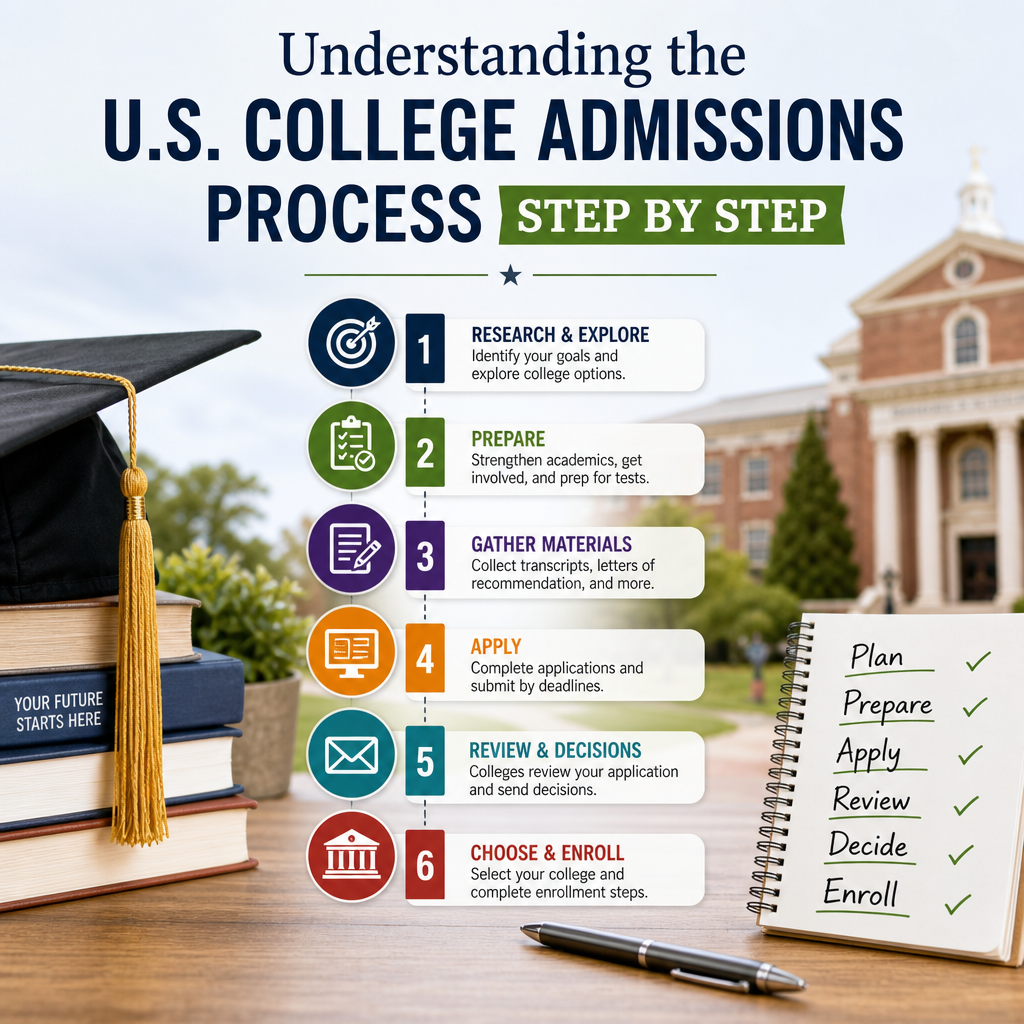
Understanding the U.S. College Admissions Process Step by Step
The US college admissions process can seem complicated at first, but breaking it into clear steps makes it much easier to manage. This guide walks you through everything from researching schools to submitting applications so you can stay organized and confident along the way.
By: Jennifer Collins on July 30, 2026
The U.S. college admissions process can feel overwhelming at first, especially if you are trying to compare deadlines, tests, essays, financial aid forms, and application platforms all at once. The good news is that the process becomes much easier when you break it into clear steps. Whether you are a high school student, a parent, or a guidance counselor helping someone plan ahead, understanding how college admissions works can reduce stress and help you make better decisions.
In this guide, you’ll learn how the U.S. college admissions process works from start to finish, what colleges typically look for, and how to stay organized along the way.
What the U.S. College Admissions Process Looks Like
The U.S. college admissions process is not the same at every school. Some colleges review applications holistically, meaning they consider grades, rigor of coursework, essays, activities, and personal background. Others may emphasize academic performance more heavily. Public universities, private colleges, and highly selective schools can each have different expectations.
Even with those differences, most applications follow a similar path:
Research colleges
Build your academic profile
Take required tests, if needed
Prepare application materials
Submit applications
Apply for financial aid
Compare offers and enroll
Understanding each step early can help you avoid missing deadlines and submit stronger applications.
Step 1: Start with Self-Assessment and College Research
Before filling out any applications, take time to think about what you want in a college. This step matters because the best school for one student may not be the best fit for another.
Ask yourself these questions
Do I want a large university or a smaller campus?
Am I looking for a public or private school?
Do I want to stay close to home or study in another state?
What majors, programs, or career paths interest me?
How important are factors like campus culture, athletics, internships, or research opportunities?
What is my family’s budget?
Once you answer these questions, you can build a list of schools that match your goals.
Create a balanced college list
A strong college list usually includes a mix of:
Reach schools: highly selective schools that are harder to get into
Match schools: schools where your academic profile aligns well with typical admitted students
Likely schools: schools where you are likely to be admitted based on your profile
A balanced list gives you options and reduces the risk of ending up with too few acceptances.
Step 2: Understand Admission Requirements
Every college sets its own admission standards. Some require standardized test scores, while others are test-optional or test-free. Some schools ask for interviews or portfolios, especially for art, music, or theater programs.
Common application components
Most colleges ask for some combination of:
High school transcript
GPA and course history
Standardized test scores, if required or submitted
Personal essay or statement
Letters of recommendation
Activity list or resume
Application fee or fee waiver request
Some majors or special programs may have additional requirements, such as auditions, supplemental essays, or portfolio submissions.
Review each school’s website carefully
This is one of the most important habits in the U.S. college admissions process. Admission rules can vary even within the same university. For example, the engineering school may have different requirements than the liberal arts college at the same institution.
Step 3: Focus on Your Academic Record
Colleges pay close attention to your academic performance throughout high school, not just your senior-year grades. Admissions officers often look at the strength of your courses as well as your grades.
What matters academically
GPA
Class rigor, such as honors, AP, IB, or dual-enrollment courses
Grade trends over time
Subject preparation for your intended major
A student who challenges themselves academically and shows steady improvement often presents a strong profile. For selective schools, course rigor can matter just as much as GPA.
If your grades are not perfect
Many students worry they are “not good enough” because of one rough semester or a lower grade in a difficult subject. Colleges usually consider context. A strong upward trend, difficult coursework, or personal circumstances may help explain your record.
Step 4: Take Standardized Tests if Needed
The role of SAT and ACT scores has changed over time. Many colleges now offer test-optional admissions, which means students can choose whether to submit scores. Other schools still require tests, especially certain programs or scholarships.
What to do
Check each college’s testing policy
Decide whether your scores strengthen your application
Register for test dates early if you plan to submit scores
Leave time for retakes if needed
Test-optional does not mean test irrelevant
Even at test-optional schools, strong test scores may still help in some cases. On the other hand, if your scores do not reflect your academic ability, you may choose not to submit them where allowed.
Step 5: Build a Strong Application Strategy
The U.S. college admissions process is easier when you approach it like a project with deadlines and milestones. Strong planning makes the entire experience less stressful.
Organize your application materials
Create a folder for each college with:
Login information
Deadlines
Required documents
Essay prompts
Recommendation letter contacts
Financial aid requirements
A spreadsheet can also help you compare schools side by side.
Know the application platforms
Many students apply through one or more of the following:
Common Application
Coalition Application
University-specific portals
Each platform has its own setup process, but the basic information you enter is usually similar.
Step 6: Write Thoughtful Essays
The college essay gives admissions officers a chance to hear your voice. It is not just a writing sample—it is an opportunity to show personality, reflection, and maturity.
What makes a good essay
A strong essay usually does one or more of the following:
Tells a personal story with a clear point
Reveals something meaningful about your values or experiences
Shows growth, resilience, curiosity, or self-awareness
Feels specific and authentic
Essay tips that help
Start early
Brainstorm several topics before choosing one
Write in your natural voice
Focus on one clear story or idea
Revise more than once
Ask a teacher, counselor, or trusted adult to review it
Avoid turning the essay into a résumé in paragraph form. Admissions officers already have your activity list and transcript. Use the essay to add depth.
Step 7: Request Strong Letters of Recommendation
Some colleges require letters from teachers, counselors, or other recommenders. These letters can support your academic and personal strengths.
How to ask
Ask early, ideally weeks before the deadline. Choose recommenders who know you well and can speak to your work ethic, character, or growth.
When you make the request, provide:
Your resume or activity list
A reminder of classes or projects you completed with them
Information about your college goals
The deadline and submission instructions
A thoughtful request makes it easier for your recommender to write a detailed and useful letter.
Step 8: Complete the Application Carefully
Once your materials are ready, submit the application with attention to detail. Small mistakes can create unnecessary problems, so review everything before hitting “submit.”
Double-check these items
Legal name and contact information
Academic history
Course list
Activities and honors
Essay uploads
Recommendation letter status
Application fee or waiver
Submission confirmation
It helps to ask a parent, counselor, or teacher to proofread important sections. A second pair of eyes can catch errors you may miss.
Step 9: Apply for Financial Aid Early
For many families, financial aid is a major part of the college decision. The U.S. college admissions process often runs alongside the financial aid process, and students should pay attention to both.
Common financial aid forms
FAFSA: used to determine eligibility for federal student aid and, in some cases, state or institutional aid
CSS Profile: required by some private colleges and universities
Institutional scholarship applications
Why timing matters
Some aid is awarded on a first-come, first-served basis, especially at certain schools or for specific scholarships. Missing a deadline can reduce the aid available to you.
Keep your documents ready
You may need tax information, income records, or other family financial details. Gather these documents early so you are not scrambling near the deadline.
Step 10: Track Admissions Decisions
After you submit everything, colleges begin reviewing applications. Notification dates vary by school and by application plan.
Common decision types
Early Decision: binding commitment if admitted
Early Action: non-binding early application
Regular Decision: standard deadline and notification timeline
Rolling Admission: applications reviewed as they are received
Each option has trade-offs. Early Decision can signal strong interest but limits flexibility. Early Action gives you an earlier answer without requiring commitment. Regular Decision keeps your options open longer.
What to do after decisions arrive
If you are admitted to multiple schools, compare:
Cost after financial aid
Academic program strength
Campus environment
Housing and location
Career or internship opportunities
If you are waitlisted or denied, do not assume the process is over. Some students are admitted from waitlists later, and others may choose to strengthen a gap-year plan or attend a different institution first.
Step 11: Make Your Final College Decision
Once you receive your offers, it is time to choose the school that best fits your academic, financial, and personal needs.
How to compare offers
A smart decision should consider more than prestige. Ask:
Which school offers the best value?
Where will I thrive academically?
Which campus feels like the best fit?
What support services are available?
Which school aligns with my long-term goals?
If possible, visit campuses again, attend admitted student events, or talk with current students before deciding.
Submit your enrollment deposit
After choosing a school, confirm your place by submitting the enrollment deposit by the deadline. You will also need to complete next steps such as housing forms, course registration, and orientation.
Common Mistakes to Avoid
The U.S. college admissions process is manageable, but students often make avoidable mistakes. Watch out for these:
Waiting too long to start essays
Ignoring school-specific requirements
Missing deadlines
Submitting rushed or incomplete applications
Forgetting to apply for financial aid
Choosing colleges based only on rankings
Failing to proofread materials
Not keeping copies of submitted forms
A simple checklist can prevent many of these problems.
Practical Example: A Simple Admissions Timeline
Here is a sample timeline for a student starting junior year:
Junior year
Research colleges
Take challenging classes
Begin SAT or ACT preparation, if needed
Visit campuses or attend virtual tours
Build an activity resume
Summer before senior year
Draft college essays
Finalize college list
Organize deadlines
Request recommendation letters early
Complete application profiles
Senior fall
Submit early applications
Finish regular decision applications
File financial aid forms
Monitor portals for missing documents
Senior spring
Compare offers
Review aid packages
Commit to a school
Prepare for enrollment
This kind of structure can make the process feel far less chaotic.
Frequently Asked Questions
1. When should I start the U.S. college admissions process?
It is best to start during junior year of high school, or even earlier if possible. Early planning gives you time to research schools, strengthen your academic record, prepare for tests, and write stronger essays. Waiting until senior year can make the process feel rushed.
2. Do all colleges require SAT or ACT scores?
No. Many colleges are test-optional, and some are test-free. However, policies change, and some majors or scholarship programs may still consider test scores. Always check each school’s official admissions page before deciding whether to submit scores.
3. What do colleges look for besides grades?
Colleges often consider course rigor, essays, recommendation letters, extracurricular involvement, leadership, personal background, and demonstrated interest. Selective schools usually review applications holistically, which means they evaluate more than just GPA.
4. How many colleges should I apply to?
There is no single right number, but many students apply to a balanced list of schools across reach, match, and likely categories. The right number depends on your goals, budget, and how competitive your target schools are. Focus on quality and fit rather than quantity alone.
5. What if I miss an application deadline?
If you miss a deadline, contact the admissions office right away. Some schools may allow a small grace period, while others may not. You may still be able to apply through rolling admissions at other institutions or consider a later entry term if available.
The U.S. college admissions process may seem complicated, but it becomes much more manageable when you treat it as a series of clear, intentional steps. Start by researching colleges that fit your goals, then build a strong academic record, understand each school’s requirements, and stay organized with deadlines and documents. Write essays that sound like you, ask for recommendations early, and pay close attention to financial aid so you can make a smart decision after admissions results arrive.
Most importantly, remember that college admissions is not only about getting into the “best” school on paper. It is about finding a place where you can grow academically, personally, and professionally. A thoughtful process gives you better choices and more confidence when decision time comes. If you begin early, stay organized, and focus on fit as well as opportunity, you will be in a much stronger position to navigate the road ahead.
Jennifer, M.Ed., holds a degree in Higher Education Administration, with
a focus on U.S. college financial aid, admissions policy, and student
support systems. She researches and writes about scholarships, federal
aid programs, and the college planning process to help students and
families make informed, well-supported decisions.