Higher Education Trends 2026: Changes Affecting American Colleges
Higher education trends 2026 are reshaping American colleges as institutions face new enrollment pressures, rising expectations, and fast-moving technology changes. For students and families, that means more options, but also a greater need to understand how colleges are adapting and where they’re headed next.
By: Jennifer Collins on July 30, 2026
American colleges are heading into 2026 with more pressure, more innovation, and more public scrutiny than ever before. From enrollment shifts and student expectations to AI adoption and workforce alignment, higher education trends 2026 reflect a system that is changing in real time. Institutions that adapt quickly will be better positioned to serve students, while those that resist change may struggle to stay competitive.
For students, families, faculty, and administrators, understanding these shifts is no longer optional. It affects where students enroll, how they learn, what they pay, and how colleges prove their value. Below, we’ll break down the most important developments shaping American colleges in 2026 and what they mean in practice.
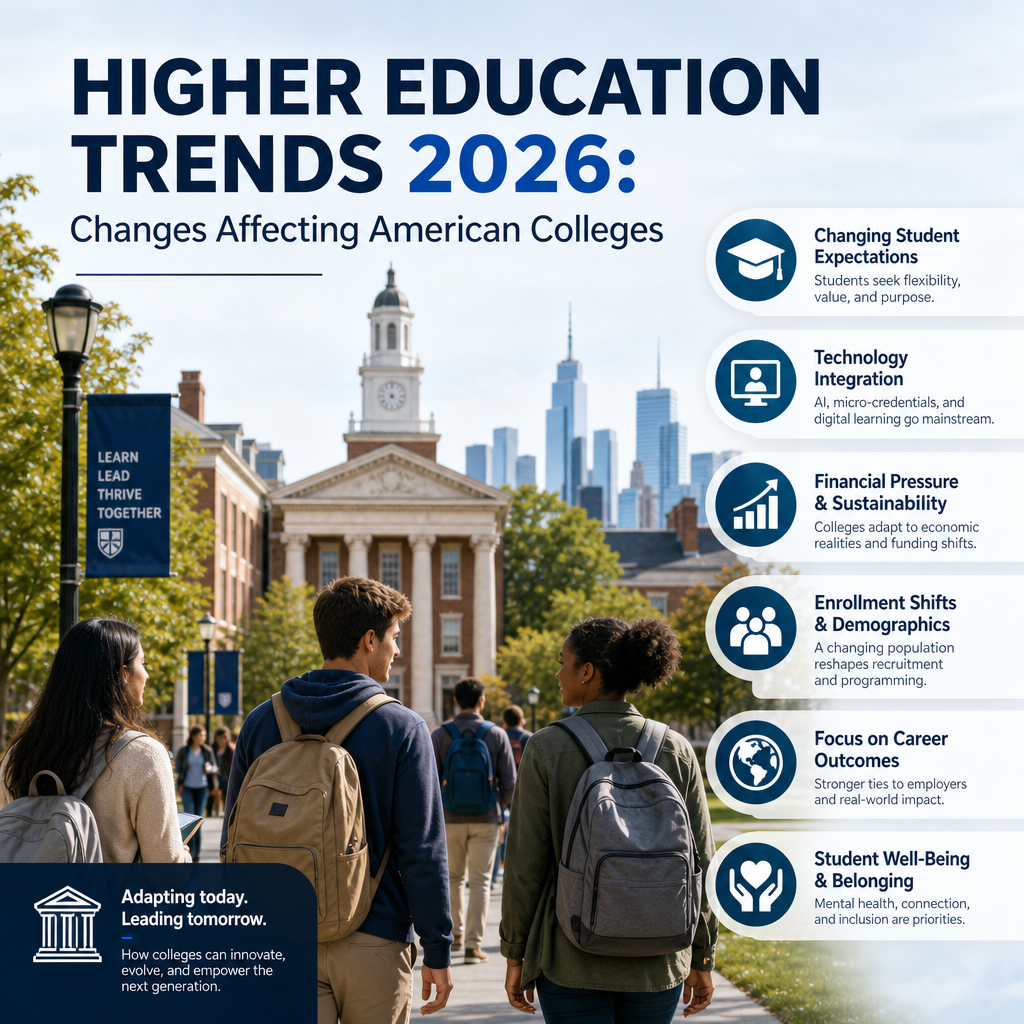
Higher Education Trends 2026: The Big Picture
The higher education landscape in 2026 is being shaped by a few major forces:
Demographic change and enrollment competition
Rising concerns about cost and student debt
Greater demand for career-focused education
Rapid growth in AI and digital learning tools
Increased pressure for accountability and measurable outcomes
These trends are not isolated. They interact with each other. A college facing declining enrollment may invest more heavily in online programs. A university trying to improve student retention may use AI-powered advising. A community college may expand short-term credentials to better serve local employers.
The result is a more flexible, more competitive, and more outcomes-driven system.
Enrollment Pressures and the Search for New Student Markets
One of the clearest higher education trends 2026 is the continued pressure on enrollment, especially at smaller private colleges and some regional institutions. The traditional pool of recent high school graduates is shifting, and many campuses are working harder to attract adult learners, transfer students, and part-time students.
Why enrollment is changing
Several factors are influencing college enrollment patterns:
Lower birth rates over time in many parts of the country
Stronger competition from community colleges, online programs, and workforce training
Student concerns about affordability and return on investment
More families questioning the value of a four-year degree for every career path
This does not mean college is losing relevance. It means institutions must be more intentional about who they serve and how they communicate value.
What colleges are doing
To respond, many colleges are:
Expanding transfer pathways from community colleges
Recruiting working adults with evening, hybrid, and online options
Designing programs around local labor market demand
Strengthening outreach to first-generation and underrepresented students
A university that once relied mainly on traditional freshmen may now build an entire recruitment strategy around adult learners seeking a degree completion program.
Student Demand for Career Outcomes Is Rising
Families and students want clearer answers about what happens after graduation. In 2026, higher education trends are strongly shaped by questions like:
Will this degree lead to a job?
What kind of salary can I expect?
Are internships built into the program?
Does this college have employer connections?
Colleges can no longer assume that prestige alone will attract applicants. Students want evidence that a program prepares them for real opportunities.
Career-focused learning is expanding
Schools are responding with:
More applied majors and professional certificates
Stronger internship and co-op requirements
Microcredentials in targeted skill areas
Employer advisory boards for academic programs
For example, a liberal arts college may add digital marketing certificates or data literacy courses to help students build practical skills alongside broader academic learning. That kind of flexibility is becoming a competitive advantage.
The value conversation is changing
In the past, higher education marketing often centered on campus life, tradition, and reputation. Those things still matter, but they are no longer enough.
Today, colleges must show:
Program relevance
Graduate success
Access to hands-on experience
Clear pathways from classroom to career
This shift is one of the most important higher education trends 2026 because it affects recruiting, retention, curriculum design, and student satisfaction all at once.
Artificial Intelligence Is Reshaping Teaching and Operations
AI has become one of the most influential forces in higher education. In 2026, colleges are not just experimenting with AI—they are building policies, training faculty, and redesigning workflows around it.
How AI is being used on campus
Colleges are using AI for a wide range of tasks, including:
Drafting routine communications
Supporting tutoring and study tools
Helping students brainstorm and revise writing
Analyzing retention data
Automating parts of admissions and student support
Some instructors are also incorporating AI literacy into the curriculum so students learn how to evaluate, question, and use these tools responsibly.
The academic integrity challenge
AI brings opportunity, but it also creates serious concerns. Colleges are still working through questions such as:
How should AI-assisted work be disclosed?
What counts as acceptable use in an assignment?
How can instructors assess original thinking?
What policies protect both learning and fairness?
The best institutions are not treating AI as a passing trend. They are developing clear guidelines, offering faculty development, and focusing on ethical use. This matters because students graduating in 2026 and beyond will enter workplaces where AI fluency is increasingly expected.
Online, Hybrid, and Flexible Learning Continue to Grow
Flexible learning is now a standard expectation rather than a temporary response to disruption. One of the strongest higher education trends 2026 is the ongoing expansion of online and hybrid formats.
Why flexibility matters
Students often balance school with:
Full-time jobs
Parenting responsibilities
Commutes
Military service
Caregiving duties
Rigid schedules can make college inaccessible. Flexible options help more learners participate without sacrificing other responsibilities.
What’s changing in program design
Many colleges are improving flexibility through:
Asynchronous online classes
Hyflex models that blend in-person and virtual participation
Accelerated terms
Modular course formats
Weekend and evening scheduling
A student finishing a degree while working full-time may choose a hybrid business program with one campus visit per week and the rest online. That type of design can expand access while supporting completion.
Quality still matters
Flexibility alone is not enough. Students expect online programs to be well organized, interactive, and supported by real advising and tutoring. Colleges that succeed in this space invest in instructional design, faculty training, and student support services.
Mental Health and Student Well-Being Remain Top Priorities
Student well-being is no longer treated as a side issue. In 2026, colleges are under pressure to support mental health, reduce barriers to care, and create environments where students can succeed academically and personally.
What colleges are focusing on
Institutions are expanding:
Counseling services
Peer support programs
Crisis response protocols
Wellness education
Faculty and staff training on student distress
They are also trying to reduce stigma so students feel comfortable seeking help early.
A broader view of support
Mental health support now connects to academic success, retention, and campus climate. A student struggling with anxiety or burnout may miss class, fall behind, and eventually stop out. Colleges that intervene earlier can improve outcomes and student experience.
The challenge is that demand often outpaces resources. As a result, schools are using a more layered approach:
Basic wellness education for all students
Targeted outreach to at-risk groups
Referrals to counseling and community resources
Training for faculty, advisors, and residence staff
This whole-campus model is becoming more common across American colleges.
College Affordability and Financial Transparency Are Under More Scrutiny
Cost remains one of the biggest concerns in higher education. In 2026, students and parents are paying closer attention to total cost, not just tuition. They want to understand housing, fees, books, transportation, and the real out-of-pocket burden.
Financial transparency is becoming essential
Colleges are expected to communicate:
Tuition and fees clearly
Net price estimates
Scholarship and aid options
Loan implications
Graduation and repayment information
Schools that simplify financial aid language and improve advising can reduce confusion and build trust.
Shorter and lower-cost pathways are gaining interest
To address affordability, institutions are expanding:
Associate-to-bachelor’s transfer routes
Community college partnerships
Competency-based education
Accelerated degree completion tracks
Certificate programs with stackable credentials
These options help students move toward a credential without taking on unnecessary cost or time.
Workforce Partnerships Are Getting Stronger
Another major higher education trend 2026 is the deeper connection between colleges and employers. Institutions are increasingly expected to show how their programs fit local and national workforce needs.
What these partnerships look like
Colleges are collaborating with employers in practical ways:
Internship pipelines
Apprenticeships
Curriculum advisory councils
Guest lectures and employer-led workshops
Job placement support
Industry-recognized certifications
This helps students build relevant skills and gives employers a clearer sense of graduate preparedness.
Why this matters for colleges
Workforce alignment can improve:
Enrollment in high-demand programs
Graduate employment outcomes
Community trust
Funding opportunities and partnerships
For example, a regional college might partner with healthcare providers to expand nursing pathways or with tech firms to develop cybersecurity training. These collaborations make academic programs more responsive and more attractive to students.
Accreditation, Accountability, and Public Trust Are Front and Center
Public confidence in higher education has become more fragile, so colleges are under increasing pressure to prove that they deliver real value. That means more attention to accreditation, assessment, and outcomes.
What accountability looks like now
Colleges are expected to provide evidence of:
Student learning
Graduation and retention outcomes
Job placement or further education outcomes
Program quality and continuous improvement
In many cases, that means better data systems and clearer reporting.
Transparency builds trust
Students and families want to know what they are getting for their money. Trustees, policymakers, and accreditors want proof that institutions are fulfilling their mission. The schools that respond best are those that use data responsibly and communicate results honestly.
This is especially important in an environment where skepticism can spread quickly. A college that shares clear program outcomes and explains how it supports student success can stand out in a crowded market.
Faculty Roles Are Evolving
Faculty work is also changing in 2026. Professors are still central to higher education, but the expectations around teaching, advising, technology use, and student engagement are broader than before.
New expectations for instructors
Faculty are increasingly asked to:
Teach in hybrid and online formats
Use learning platforms effectively
Integrate AI policy into coursework
Support career readiness
Advise students more proactively
This can be a lot to balance, especially without enough training or time. Institutions that invest in faculty development are more likely to see positive results.
Teaching and technology are intersecting
Many instructors are rethinking assignment design so students demonstrate critical thinking rather than simply producing generic AI-generated work. That may include:
Oral presentations
In-class writing
Project-based assessments
Reflective journals
Real-world case studies
These approaches can improve engagement while making learning more authentic.
Diversity, Inclusion, and Belonging Remain Important
American colleges continue to serve increasingly diverse student populations. In 2026, institutions are still working to create environments where students from different backgrounds feel respected, supported, and able to thrive.
What colleges are prioritizing
Efforts often include:
Inclusive classroom practices
First-generation student support
Cultural centers and identity-based programming
Accessibility improvements
Bias reporting and campus climate review
These efforts are not just about messaging. They affect retention, student engagement, and overall campus health.
Inclusion is tied to success
When students feel like they belong, they are more likely to stay enrolled and participate fully in campus life. That is why inclusion remains one of the most enduring higher education trends 2026.
Practical Takeaways for Students and Families
If you are evaluating colleges in 2026, focus on the factors that will matter most after enrollment.
Ask these questions:
What are the graduation and transfer outcomes for this program?
How does the college support internships, research, or hands-on experience?
What flexible learning options are available?
How transparent is the school about total cost and financial aid?
What student support services are available for mental health, advising, and career planning?
These questions help you look beyond brochures and marketing claims.
Frequently Asked Questions
1. What are the biggest higher education trends 2026 affecting American colleges?
The biggest trends include enrollment pressure, stronger demand for career-focused programs, wider use of AI, growth in online and hybrid learning, greater attention to student mental health, affordability concerns, and increased accountability for outcomes. Colleges are adjusting their academic offerings and support systems to stay competitive and relevant.
2. Why is enrollment such a challenge for many colleges in 2026?
Enrollment is affected by demographic shifts, affordability concerns, and changing student preferences. Fewer traditional-age students in some regions and more competition from online, community college, and workforce programs are making recruitment harder. Colleges are expanding outreach to adult learners and transfer students to offset these changes.
3. How is AI changing higher education?
AI is being used for tutoring support, administrative tasks, student advising, and learning assistance. At the same time, colleges are creating policies to address academic integrity and ensure responsible use. AI literacy is becoming an important skill for both students and faculty.
4. Are online and hybrid programs still growing?
Yes. Flexible learning remains a major priority for students who balance school with work, family, or other responsibilities. Colleges are expanding online, hybrid, and asynchronous options, but they must also maintain strong academic quality and student support.
5. What should students look for when choosing a college in 2026?
Students should look for clear career outcomes, transparent costs, flexible learning options, academic support, internship opportunities, and a campus environment that supports well-being and belonging. The best choice is not always the most famous school, but the one that fits the student’s goals and circumstances.
Higher education trends 2026 show a system in transition. Colleges are adapting to enrollment pressure, new technology, affordability concerns, and a stronger demand for practical outcomes. At the same time, students are asking smarter questions about value, support, flexibility, and career readiness. That makes this moment both challenging and promising.
The institutions that succeed will be the ones that listen closely to students, invest in faculty and support services, and build programs aligned with real-world needs. They will also be transparent about cost, thoughtful about AI, and committed to helping learners finish what they start.
For students and families, the key is to look beyond surface-level marketing and evaluate whether a college truly supports long-term success. For colleges, the message is equally clear: adapt with purpose, communicate with honesty, and build around outcomes that matter.
The future of American higher education is not fixed. It is being shaped now by the decisions colleges make in 2026.
Jennifer, M.Ed., holds a degree in Higher Education Administration, with
a focus on U.S. college financial aid, admissions policy, and student
support systems. She researches and writes about scholarships, federal
aid programs, and the college planning process to help students and
families make informed, well-supported decisions.