How Artificial Intelligence Is Changing Everyday Life in the United States
Artificial intelligence is no longer a futuristic idea reserved for science fiction or high-tech labs. It is already woven into daily routines, often in ways people barely notice. From smartphone assistants to safer roads, smarter shopping, faster healthcare tools, and more efficient workplaces, artificial intelligence is changing everyday life across the United States in practical, measurable ways.
For many Americans, AI shows up in simple moments: a streaming service recommending a show, a map app rerouting traffic, or an email filter catching spam before it reaches the inbox. But behind those conveniences is a larger shift. Businesses, schools, hospitals, and local governments are using AI to work faster, make decisions more efficiently, and personalize services.
This article explores how artificial intelligence is shaping life in the U.S., where it helps most, what concerns people should keep in mind, and how to navigate this fast-moving technology with confidence.
What Artificial Intelligence Means in Everyday Life
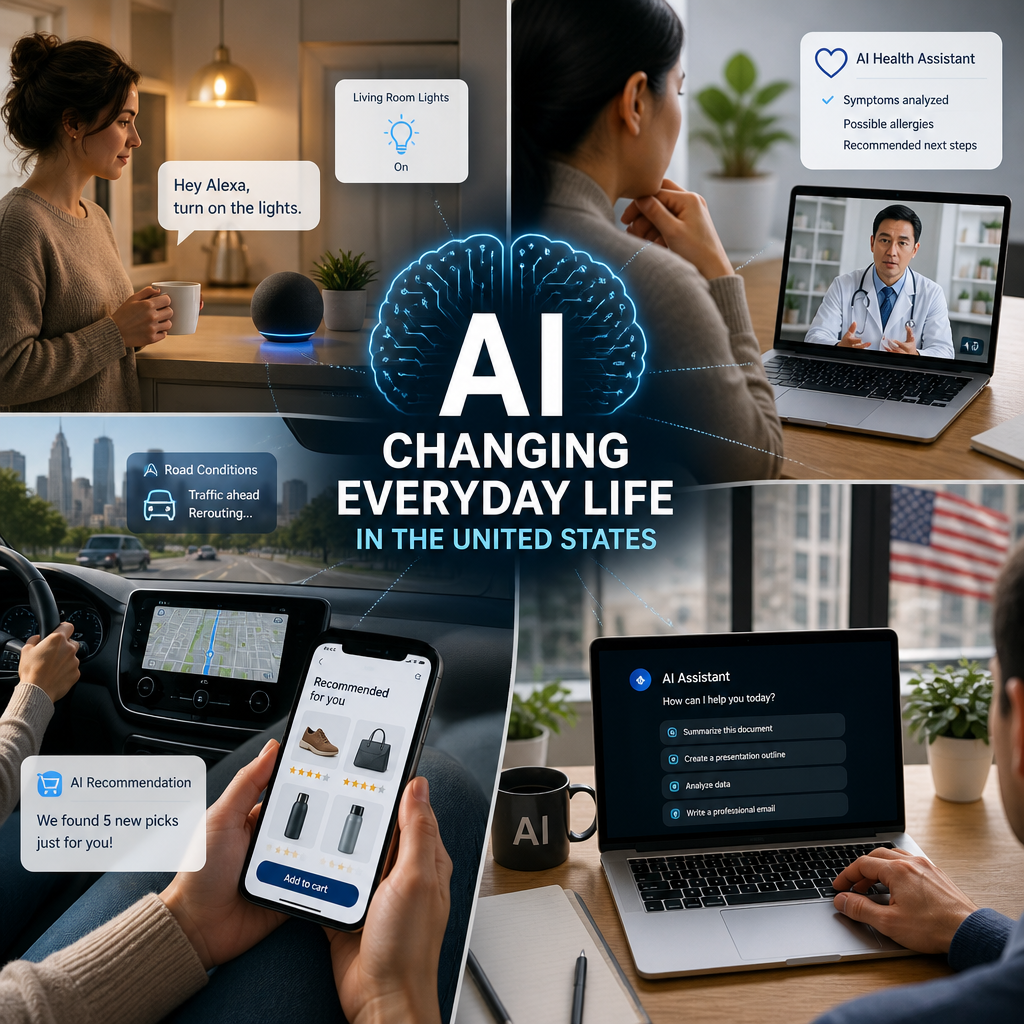
Artificial intelligence refers to computer systems that can perform tasks usually associated with human intelligence, such as recognizing patterns, understanding language, making predictions, and learning from data. In everyday life, AI often works quietly in the background.
Common examples people use every day
- Voice assistants like Siri, Alexa, and Google Assistant
- Navigation apps that adjust routes based on traffic
- Streaming platforms that recommend movies, music, or shows
- Online shopping tools that suggest products
- Email spam filters
- Fraud detection systems used by banks and credit card companies
These tools may feel ordinary now, but they represent a major shift in how Americans interact with technology. Instead of simply responding to commands, many digital tools now anticipate needs and adapt to behavior.
How Artificial Intelligence Is Changing Everyday Life Across the United States
The impact of artificial intelligence goes far beyond convenience. It is reshaping major parts of daily life, from healthcare and education to transportation and home management.
Healthcare is becoming more efficient and personalized
AI is helping doctors, hospitals, and patients in several important ways. It can analyze large amounts of medical data, support earlier detection of certain conditions, and reduce administrative tasks that slow down care.
Practical ways AI appears in healthcare
- Scheduling systems that help patients book appointments faster
- Tools that summarize medical records for clinicians
- Imaging software that helps identify patterns in X-rays, MRIs, and scans
- Chatbots that answer basic patient questions
- Wearable devices that track heart rate, sleep, and activity
For example, a patient with a chronic condition may use a smartwatch to monitor health trends and share those readings with a doctor. That data can help identify issues earlier and support better long-term management. AI does not replace medical professionals, but it can help them work more efficiently and make more informed decisions.
Transportation is getting smarter and safer
AI is also changing how Americans get around. Navigation apps use real-time data to reduce delays, while rideshare platforms use AI to match riders and drivers efficiently. In some cities, public transportation systems use predictive analytics to improve scheduling and maintenance.
Where AI shows up in transportation
- Traffic apps that predict congestion
- Driver-assist features in modern vehicles
- Route optimization for delivery fleets
- Transit planning tools used by city agencies
- Ride-matching systems in rideshare apps
A common example is a commuter who leaves work and receives a suggested alternate route because of an accident ahead. That recommendation may save time, reduce stress, and even lower fuel use. As vehicle technology evolves, AI will likely continue to influence safety features, logistics, and urban mobility.
Shopping and consumer experiences feel more personalized
Retailers have embraced artificial intelligence to better understand customer preferences and improve the shopping experience. Online stores use AI to recommend products, manage inventory, and answer customer questions. Physical stores are also using AI-powered systems to track demand and reduce stock shortages.
Examples of AI in shopping
- Product recommendations based on browsing history
- Virtual shopping assistants
- Dynamic inventory management
- Automated customer service chat tools
- Fraud detection during online payments
This can make shopping more efficient for consumers. A customer looking for running shoes, for instance, may quickly see styles that match their size, budget, and preferences. While these recommendations can save time, they also raise questions about data privacy and how much personal information companies collect.
Education tools are more adaptive
Schools and universities across the United States are exploring artificial intelligence to support teaching and learning. AI tools can help students study, provide personalized practice, and assist teachers with time-consuming tasks.
How AI supports education
- Adaptive learning platforms that adjust to student progress
- Writing tools that help with editing and grammar
- Tutoring apps that answer basic academic questions
- Administrative systems that streamline scheduling and communication
- Accessibility tools for students with disabilities
For example, a student struggling with algebra might use an AI-powered learning platform that provides extra practice on specific problem types. A teacher might use AI to sort assignments or draft lesson feedback more quickly. Used thoughtfully, these tools can improve efficiency and support more personalized instruction.
Home life is more automated and connected
Smart home technology is one of the most visible signs that artificial intelligence is becoming part of everyday routines. Thermostats learn household patterns, security cameras detect unusual activity, and appliances can be controlled remotely.
AI-powered home examples
- Smart speakers and voice assistants
- Thermostats that adjust based on habits
- Robot vacuums that map rooms
- Security systems with motion detection
- Smart lighting and energy management tools
These devices can save time and improve convenience. A family might use a smart thermostat to reduce energy waste, or a homeowner might check a door camera from a phone while traveling. As homes become more connected, AI is helping people manage routines with less effort.
Workplaces are changing across industries
AI is reshaping office work, customer service, manufacturing, logistics, and more. In many jobs, it acts as a productivity tool that helps people complete repetitive tasks faster. In others, it supports analysis, communication, and planning.
Where AI helps at work
- Drafting emails and reports
- Summarizing meetings
- Sorting large datasets
- Predicting equipment maintenance needs
- Improving customer support response times
A small business owner, for example, might use AI to draft marketing copy or analyze sales patterns. A warehouse manager might rely on AI to forecast inventory needs. These tools can improve efficiency, but they also require workers to learn how to use them responsibly and critically.
The Benefits of AI for Americans
The rapid adoption of artificial intelligence is happening because it offers real benefits. For many people, AI saves time, improves access to services, and reduces repetitive work.
Key advantages include
- Faster access to information
- More personalized experiences
- Better productivity at home and work
- Improved safety features in vehicles and digital services
- More efficient healthcare and logistics systems
AI can also help people with disabilities by powering speech-to-text tools, real-time captions, screen readers, and other accessibility features. For users who need technology to adapt to them, AI can make digital spaces more usable and inclusive.
Concerns and Challenges Americans Should Watch
Even though artificial intelligence brings many benefits, it also creates important concerns. People should understand both the promise and the limits of these systems.
Privacy and data use
AI systems often rely on large amounts of data. That may include browsing behavior, location history, health information, or purchase patterns. Consumers should know what data they are sharing and how companies use it.
Bias and fairness
AI systems can reflect biases found in the data they learn from. That can lead to unfair outcomes in hiring, lending, policing, or other sensitive areas. Careful design, testing, and oversight matter.
Misinformation and deepfakes
AI can generate convincing text, images, audio, and video. While this has creative uses, it also makes it easier to spread misleading content. Americans need to stay alert and verify sources, especially when content seems surprising or emotionally charged.
Job disruption and skill shifts
Some tasks once done by people are now automated or assisted by AI. That does not always mean jobs disappear, but it does mean workers may need new skills. Many industries are changing, and lifelong learning is becoming more important.
How to Use AI Responsibly in Daily Life
People do not need to avoid AI to use it wisely. The key is to stay informed and use tools thoughtfully.
Practical tips for everyday users
- Review privacy settings on apps and devices
- Check whether AI-generated results are accurate before acting on them
- Use strong passwords and two-factor authentication
- Be cautious with sensitive personal or financial information
- Compare AI recommendations with trusted human judgment
If you use AI for work, school, or personal tasks, treat it like a helpful assistant rather than an unquestionable authority. It can save time and improve convenience, but it is not perfect.
What the Future May Hold
The influence of artificial intelligence in the United States will likely continue to grow. As tools become more capable, they will probably appear in more consumer products, workplace software, public services, and community systems.
Likely areas of continued growth
- Smarter healthcare tools
- More advanced home automation
- Better digital assistants
- Improved logistics and delivery systems
- More personalized learning platforms
At the same time, policymakers, companies, educators, and consumers will need to keep asking important questions about safety, fairness, transparency, and accountability. The future of AI should not just be about what technology can do. It should also be about what it should do.
Frequently Asked Questions
1. What is artificial intelligence in simple terms?
Artificial intelligence is technology that allows computers to perform tasks that usually require human intelligence. These tasks can include recognizing speech, identifying patterns, translating language, or making predictions based on data. In everyday life, AI powers many familiar tools like map apps, recommendation systems, and voice assistants.
2. How is artificial intelligence changing everyday life across the United States?
Artificial intelligence is changing everyday life across the United States by improving convenience, efficiency, and personalization. People use AI in healthcare, transportation, shopping, education, home automation, and workplace tools. Many of these systems operate behind the scenes, making routines faster and more connected.
3. Is AI replacing jobs in the U.S.?
AI is changing jobs more than it is simply replacing them. In many cases, it automates repetitive tasks and helps workers save time. Some roles may shrink or shift, but others are evolving to include AI oversight, data interpretation, and creative problem-solving. Workers who adapt and learn new skills are often better positioned for these changes.
4. What are the biggest risks of artificial intelligence?
The biggest risks include privacy concerns, bias in decision-making, misinformation, and overreliance on automated systems. AI tools can make mistakes, reflect flawed data, or generate misleading content. That is why human oversight, careful testing, and responsible use are so important.
5. How can I use AI safely in daily life?
You can use AI safely by reviewing privacy settings, protecting personal information, checking facts before trusting AI-generated content, and using strong security practices like two-factor authentication. It also helps to remember that AI is a support tool, not a substitute for critical thinking or expert advice.
Official Resources
- National Institute of Standards and Technology (NIST) – AI resources
- U.S. Department of Health and Human Services – AI in health care
- Federal Trade Commission – Consumer protection and AI-related guidance
- National Science Foundation – AI research and initiatives
- U.S. Government Accountability Office – Artificial intelligence reports
Conclusion
Artificial intelligence is no longer something Americans only read about in tech headlines. It is part of daily life in ways both obvious and subtle, from the apps on our phones to the systems that support healthcare, shopping, transportation, education, and work. As artificial intelligence continues to evolve, its impact across the United States will likely become even more noticeable.
The most important takeaway is that AI is a tool. Used well, it can save time, improve services, support accessibility, and help people make better decisions. Used carelessly, it can create privacy risks, spread misinformation, and reinforce bias. That is why understanding AI matters for everyone, not just engineers or business leaders.
By staying informed, asking good questions, and using technology responsibly, Americans can take advantage of AI’s benefits while avoiding many of its pitfalls. The future of everyday life will be shaped by how thoughtfully we guide this technology today.