Emerging Technologies Shaping the Future of Everyday Life
Emerging technologies are quietly reshaping everyday life, from how we work and communicate to how we manage health, energy, and transportation. As these tools become more practical and widespread, they could make daily routines faster, smarter, and more convenient than ever.
By: Peter on July 30, 2026
Technology rarely changes life all at once. More often, it slips into the background, quietly making routines faster, safer, and more convenient. That is why emerging technologies matter so much. They are not just exciting ideas for labs, startups, or investors. They are the tools, systems, and platforms that could soon shape how we work, learn, travel, shop, communicate, and care for our health.
From artificial intelligence to smart energy systems, emerging technologies are already influencing everyday decisions. Some are still early in adoption, while others are becoming part of daily life in homes, offices, and cities. Understanding what is coming next can help individuals and businesses make smarter choices and prepare for change.
What Makes Emerging Technologies Important?
Emerging technologies are innovations that are still developing but show strong potential to transform society. They often begin in specialized settings before becoming practical for mainstream use.
What makes them important is not novelty alone. Their value comes from solving real problems, such as:
Reducing time spent on repetitive tasks
Improving access to information and services
Supporting better health outcomes
Increasing energy efficiency
Making transportation and communication more seamless
In other words, emerging technologies matter because they are not just changing what we can do. They are changing what we expect life to feel like.
Emerging Technologies That Could Shape the Future
Artificial Intelligence in Daily Life
Artificial intelligence is already embedded in tools many people use every day, from search engines and voice assistants to recommendation systems and spam filters. The next phase of AI will likely be more visible and more personalized.
How AI may affect everyday routines
AI could help people:
Draft emails and summarize long documents
Organize schedules and prioritize tasks
Receive more tailored healthcare support
Get faster customer service through smart assistants
Discover products, content, or services that better match their needs
For example, a working parent might use AI-powered tools to manage appointments, compare grocery prices, and plan meals in less time. A small business owner might rely on AI to answer routine customer questions and analyze sales trends.
The opportunity is significant, but so is the need for careful use. AI systems should be accurate, transparent, and respectful of privacy. As this technology grows, users will need to understand when to trust automation and when human judgment still matters.
Smart Home Systems and Connected Living
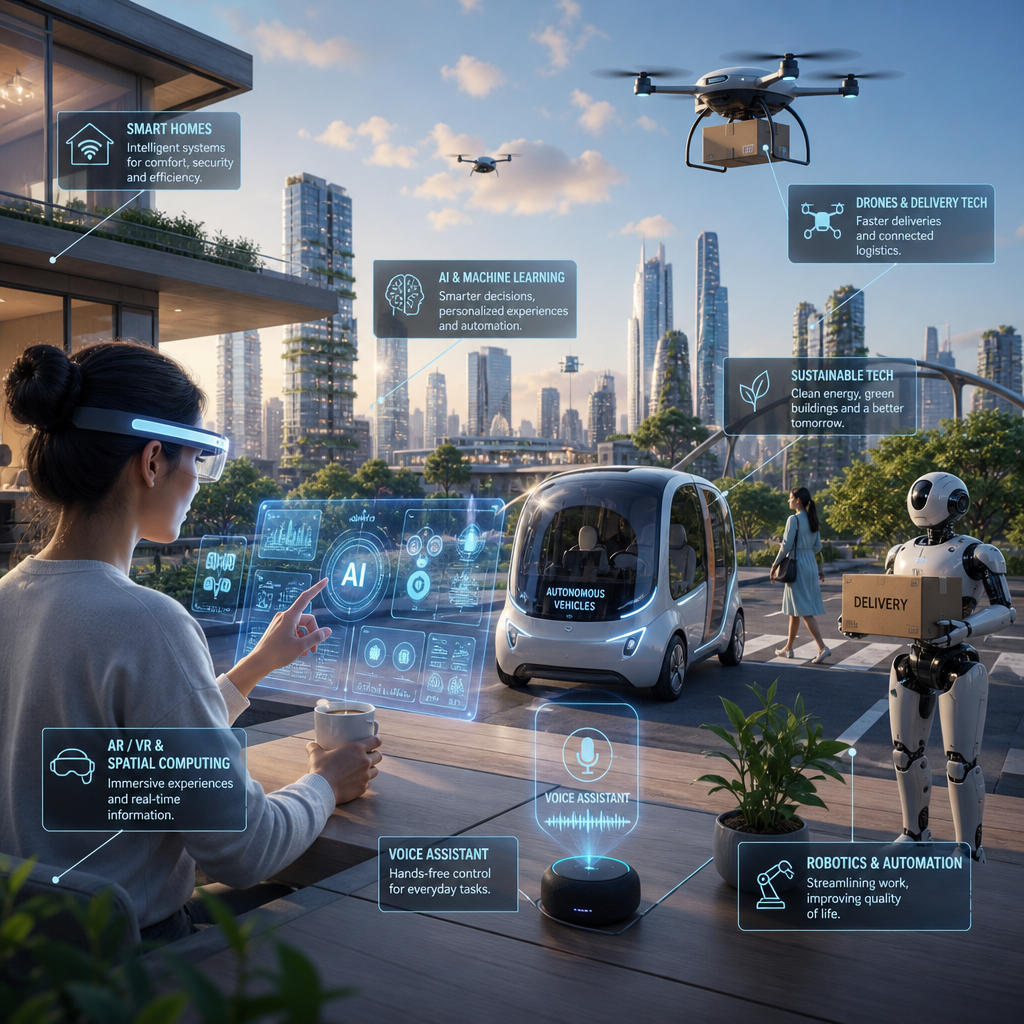
The modern home is becoming more responsive. Smart home systems can now control lighting, temperature, locks, cameras, appliances, and entertainment devices from a phone or voice assistant.
Why smart homes are becoming more common
People are drawn to smart home technology because it offers:
Convenience through remote control
Energy savings through automation
Better home security and monitoring
Greater accessibility for older adults and people with disabilities
A practical example: smart thermostats can learn household patterns and adjust heating or cooling automatically. Smart doorbells can send alerts when someone is at the front door. Connected appliances can notify homeowners when maintenance may be needed.
As these systems improve, emerging technologies in the home will likely become less about novelty and more about everyday efficiency.
Wearable Health Technology
Wearable devices have moved far beyond step counting. Many now track heart rate, sleep patterns, stress signals, oxygen levels, and activity trends. The future of wearable health technology may include even more advanced sensors and more meaningful health insights.
Everyday uses of wearables
Wearables can help people:
Monitor fitness goals
Track sleep quality
Spot patterns in daily stress
Stay aware of changes in heart health
Share data with healthcare providers
A person managing a chronic condition might use a wearable to identify early warning signs. Someone trying to build healthier habits may rely on daily activity reminders and sleep tracking.
The real promise of wearable health technology is not just data collection. It is turning passive information into actionable insight. That said, consumers should be cautious about privacy, data accuracy, and medical claims. Not every wearable is a medical device, and not every alert should be treated as a diagnosis.
Telehealth and Digital Care Platforms
Healthcare delivery has changed rapidly, and digital care platforms are now a permanent part of the system. Telehealth makes it easier for many patients to speak with medical professionals without traveling to a clinic.
How telehealth is changing access to care
Digital care tools can:
Reduce time and travel barriers
Improve follow-up care
Support routine consultations
Expand access in underserved areas
Help providers manage appointments more efficiently
For many people, telehealth is especially useful for medication questions, mental health support, and ongoing care for manageable conditions. It is not always the best choice for emergencies or situations that require physical exams, but it has become a valuable complement to in-person care.
As digital health platforms improve, they will likely combine video visits, remote monitoring, patient portals, and AI-assisted triage into more connected care experiences.
Robotics in Homes, Businesses, and Public Spaces
Robots are no longer limited to factories. They are entering warehouses, hospitals, restaurants, and even homes. Some are built to clean floors, deliver supplies, or assist with repetitive tasks. Others support skilled work in logistics, surgery, or inspection.
Practical roles for robotics
Robotics may shape everyday life by helping with:
Cleaning and maintenance
Package sorting and delivery
Assisting healthcare staff
Supporting manufacturing and inspection
Handling hazardous or physically demanding work
A warehouse robot can move goods faster and more consistently than a person doing repetitive lifting. A service robot can transport items in a hospital, freeing staff for patient-focused tasks.
The future of robotics will depend on affordability, safety, and trust. People are more likely to adopt robots that are reliable, easy to use, and clearly useful.
Augmented Reality and Mixed Reality
Augmented reality overlays digital elements on the physical world, while mixed reality blends physical and digital environments more deeply. These emerging technologies could reshape how people shop, learn, train, and navigate.
Where AR and MR may show up
Potential everyday uses include:
Trying on furniture virtually before buying
Viewing navigation prompts over real-world streets
Learning through interactive 3D lessons
Training workers in simulated environments
Helping technicians repair equipment with visual guidance
Imagine walking through a store and seeing product reviews, sizing information, or styling suggestions in real time. Or picture a student learning anatomy through an interactive 3D model rather than a flat diagram.
As devices become lighter and software becomes more intuitive, AR and MR may move from niche tools to practical daily helpers.
Autonomous and Electric Transportation
Transportation is changing in two major ways: vehicles are becoming more electric, and some are becoming more automated. While fully self-driving cars are still evolving, driver-assist features are already common in many vehicles.
The future of everyday travel
Emerging transportation technologies may lead to:
Lower emissions through electric vehicles
Smarter traffic systems that reduce congestion
Safer driving through advanced driver assistance
More efficient delivery services
Better public transit planning through data analytics
For example, electric buses can reduce pollution in cities, while smart traffic lights can adjust timing based on traffic flow. A delivery company may use route optimization software to save time and fuel.
The long-term benefit is not just convenience. It is also a more efficient transportation ecosystem that uses energy and infrastructure more wisely.
5G, Edge Computing, and Faster Connectivity
Behind many visible innovations is a less visible foundation: faster, more reliable digital infrastructure. 5G and edge computing are helping devices communicate with lower delay and greater efficiency.
Why connectivity matters
Improved connectivity supports:
Real-time video and communication
Better performance for smart devices
More responsive gaming and streaming
Safer industrial automation
Faster remote monitoring and diagnostics
Edge computing processes some data closer to where it is created instead of sending everything to a distant cloud server. That matters for speed, privacy, and reliability.
As more devices connect to the internet, strong infrastructure will be essential for making emerging technologies practical in everyday life.
How These Technologies Will Affect Work and Home Life
The biggest changes will not happen in a single dramatic moment. They will unfold through small shifts in routine.
At work
Emerging technologies may help workers:
Automate repetitive administrative tasks
Collaborate across time zones more easily
Analyze data faster
Work remotely with better tools
Focus more on strategy, creativity, and problem-solving
This does not mean jobs will remain unchanged. Some tasks will disappear, others will evolve, and new roles will emerge. Adaptability will matter more than memorizing every detail of a tool.
At home
At home, people may use technology to:
Save energy
Improve safety
Manage health
Reduce stress
Simplify household tasks
For instance, a smart home system might lower heating costs, a wearable might encourage more movement, and a digital assistant might help organize family schedules.
Challenges That Must Be Addressed
Every major innovation brings trade-offs. The future of emerging technologies depends on solving real concerns, not just celebrating progress.
Privacy and data protection
Many new tools rely on collecting personal information. That raises questions about who owns the data, how it is stored, and how it is used.
Bias and fairness
AI systems can reflect bias if they are trained on incomplete or unbalanced data. That can lead to unfair outcomes in hiring, lending, healthcare, or public services.
Access and affordability
Not everyone can afford the latest devices or services. If technology advances without broad access, it can widen existing gaps.
Security and reliability
Connected systems must be protected from misuse, hacking, and technical failure. The more a device controls, the more important security becomes.
These issues do not mean innovation should slow down. They mean it should move forward responsibly.
How to Prepare for the Future of Emerging Technologies
You do not need to become a tech expert to benefit from what is coming. A few practical habits can help you stay ready.
Stay curious
Follow trustworthy sources and learn the basics of new tools before adopting them.
Focus on real use cases
Ask whether a technology solves an actual problem in your life.
Protect your data
Review app permissions, privacy settings, and account security regularly.
Build digital confidence
Learn how to use common platforms, update devices, and recognize scams.
Keep a human perspective
Use technology to support decisions, not replace judgment entirely.
A thoughtful approach will help you get more value from emerging technologies without feeling overwhelmed by them.
Frequently Asked Questions
1. What are emerging technologies?
Emerging technologies are new or rapidly developing tools, systems, and innovations with the potential to significantly change how people live and work. Examples include artificial intelligence, robotics, telehealth, smart home systems, and augmented reality.
2. Which emerging technologies are most likely to affect daily life soon?
Artificial intelligence, wearable health technology, smart home devices, telehealth platforms, and faster wireless connectivity are already influencing daily routines. These tools are becoming more useful because they are easier to access and integrate into everyday tasks.
3. Are emerging technologies always beneficial?
Not always. They can improve convenience, safety, and efficiency, but they can also raise concerns about privacy, bias, security, and affordability. The key is to evaluate each technology based on its real-world benefits and risks.
4. How can consumers use emerging technologies safely?
Consumers can use them safely by reviewing privacy settings, using strong passwords, keeping devices updated, and researching products before buying. It also helps to understand what data a device collects and whether that data is necessary for its function.
5. Will emerging technologies replace human jobs?
Some tasks will likely be automated, but many jobs will change rather than disappear. In many industries, technology will handle repetitive work while people focus on problem-solving, creativity, care, and decision-making. Learning new skills will remain important.
The future of everyday life will not be defined by one breakthrough alone. It will be shaped by a collection of emerging technologies working together in homes, workplaces, hospitals, schools, and cities. Artificial intelligence may help manage information overload. Smart home devices may reduce friction in daily routines. Wearables and telehealth may improve access to health support. Robotics, augmented reality, electric transportation, and faster connectivity may continue to make systems more efficient and responsive.
What makes these innovations especially important is their practical impact. The most valuable technologies are not always the most dramatic. They are the ones that save time, reduce stress, improve safety, and help people make better decisions. As these tools become more common, staying informed will help you choose wisely and adapt with confidence.
The best next step is simple: pay attention to how these technologies show up in your own life, and look for ways they can genuinely help you. That mindset will matter as much as the technology itself.
Peter B holds a degree in Journalism and has 5 years of experience covering U.S. economic policy, labor markets, and financial news. He writes data-driven news content on topics like inflation, interest rates, and employment trends.