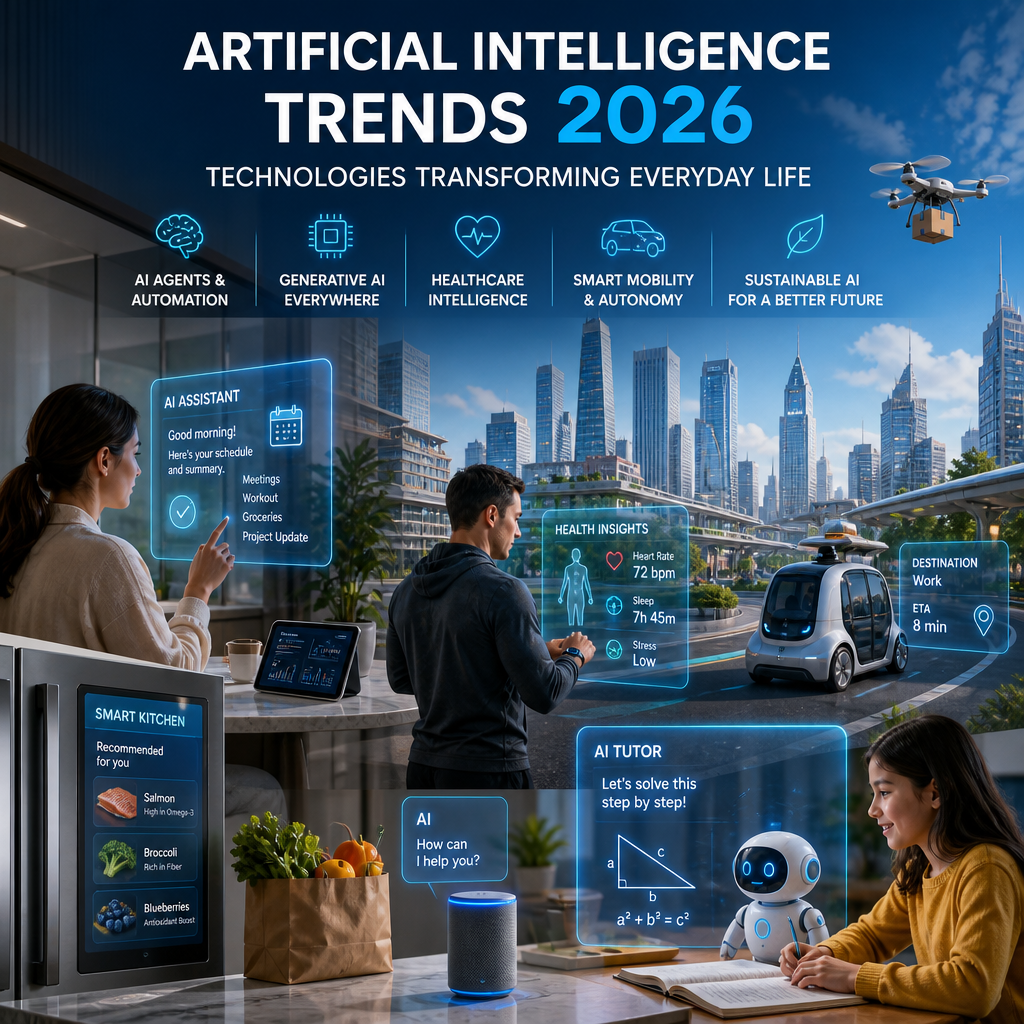
Artificial Intelligence Trends 2026: Technologies Transforming Everyday Life
Artificial Intelligence Trends 2026 are moving AI from flashy experiments into everyday tools that make life faster, easier, and more personal. From smarter assistants to built-in automation, these changes could soon reshape how we work, learn, shop, and stay connected.
By: Peter on July 30, 2026
Artificial Intelligence Trends 2026 are shaping up to be more than a list of exciting innovations. They point to practical changes that could affect how we work, shop, learn, manage our health, and interact with technology every day. What makes 2026 especially important is that AI is moving beyond novelty and into tools that feel useful, personal, and deeply embedded in daily routines.
From smarter AI assistants to more reliable automation, the next wave of artificial intelligence is likely to be defined by convenience, speed, and better decision-making. But it will also raise important questions about privacy, trust, and responsible use. Understanding these trends now can help individuals and businesses prepare for what comes next.
What Makes Artificial Intelligence Trends 2026 Different?
The biggest shift in Artificial Intelligence Trends 2026 is that AI is becoming less of a standalone tool and more of a layer inside everyday products and services. Instead of asking, “What can AI do?” people will increasingly ask, “What can this device, app, or service do for me because of AI?”
AI is becoming more practical
Earlier AI hype often centered on demos and futuristic promises. In 2026, the focus is likely to stay on practical applications such as:
Faster customer support
Better personalization in apps and services
More accurate recommendations
Smarter automation in homes and offices
Real-time translation and accessibility tools
This shift matters because practical AI adoption tends to stick. When people use a feature daily and find it genuinely helpful, it becomes part of normal life.
AI is moving closer to the user
Another defining feature of Artificial Intelligence Trends 2026 is on-device and edge AI. Instead of sending every request to the cloud, more processing may happen directly on phones, laptops, cars, wearables, and smart appliances. That can improve speed, reduce costs, and support better privacy in some cases.
AI Assistants Will Become More Capable and Context-Aware
One of the most visible Artificial Intelligence Trends 2026 will be the evolution of AI assistants. These tools are likely to become more conversational, more proactive, and better at handling complex tasks.
From simple prompts to real support
Today’s assistants can answer questions and summarize content. By 2026, many may be able to:
Track ongoing projects and remind users about deadlines
Draft emails based on context and tone
Help schedule meetings across multiple calendars
Search personal files more intelligently
Learn user preferences over time
Imagine asking your assistant to “plan next week” and getting a schedule that balances work meetings, commute times, workout goals, and family commitments. That kind of support could save time and reduce mental clutter.
Everyday examples
A parent uses an AI assistant to coordinate school pickup reminders and grocery lists.
A freelancer asks an assistant to summarize client messages, draft responses, and organize invoices.
A student uses one to turn notes into flashcards and study guides.
The key change is not just better answers. It’s better context.
Personalized AI Will Shape Shopping, Media, and Learning
Personalization has already changed how people shop and stream content, but Artificial Intelligence Trends 2026 could make it far more precise and useful.
Smarter recommendations with real context
Instead of generic suggestions, AI systems may consider:
Budget
Time constraints
Past preferences
Current goals
Seasonal or situational needs
For example, a shopping app may recommend products based not only on browsing history but also on your upcoming travel plans or the weather in your area. A learning platform may adjust the difficulty and format of lessons depending on how you learn best.
Benefits and concerns
Personalization can be convenient, but it also brings tradeoffs:
Helpful: Less time spent searching
Helpful: More relevant results
Concern: Too much data collection
Concern: Filter bubbles and over-optimization
As AI becomes more personal, users will need clearer controls over what data is collected and how it is used.
AI in Healthcare Will Focus on Access and Early Support
Healthcare is one of the most promising areas in Artificial Intelligence Trends 2026, especially for improving access, workflow efficiency, and patient support. While AI will not replace doctors, it may help people get better information sooner and support healthcare professionals with administrative and diagnostic tasks.
Where AI may help most
AI tools are already being explored for:
Appointment triage
Symptom checking
Medical documentation
Imaging support
Personalized wellness reminders
For everyday life, the biggest changes may happen before someone reaches the doctor’s office. AI-powered tools could help people decide whether to seek urgent care, schedule a routine visit, or monitor symptoms at home.
Practical example
A person notices ongoing fatigue and asks a healthcare app about possible next steps. The AI does not provide a diagnosis, but it helps organize symptoms, suggests tracking sleep and hydration, and recommends speaking with a licensed clinician. That kind of support can make healthcare feel more navigable.
Important caution
AI in health must be used carefully. Medical decisions require professional judgment, and people should treat AI output as support, not a substitute for care.
Smart Homes and AI-Powered Automation Will Feel More Seamless
Smart homes are becoming less about gimmicks and more about useful automation. In Artificial Intelligence Trends 2026, connected devices may become better at anticipating needs instead of waiting for commands.
More adaptive home systems
AI could help homes respond to patterns such as:
Preferred lighting at different times of day
Energy use habits
Temperature settings based on occupancy
Grocery reordering based on household routines
Security alerts that reduce false alarms
Rather than controlling every device manually, people may set preferences once and let the system adjust over time.
What this means for daily life
A smart home could:
Lower energy waste by adjusting HVAC settings automatically
Make mornings easier by preparing routines
Help aging adults live independently with monitoring and reminders
Improve accessibility for people with mobility or vision challenges
The best systems will be the ones that feel invisible: useful without being intrusive.
AI Will Redefine Workflows in Offices and Small Businesses
Artificial Intelligence Trends 2026 will likely have a major impact on workplace productivity. This is not only about large companies. Small businesses, freelancers, and solo entrepreneurs may benefit just as much.
Automation with judgment
AI is increasingly good at handling repetitive work such as:
Drafting first versions of documents
Summarizing meetings
Sorting support tickets
Creating reports from structured data
Generating marketing variations
That frees people to focus on strategy, creative thinking, customer relationships, and quality control.
Example of a practical workflow
A small marketing agency might use AI to:
Pull notes from a client call
Draft a project summary
Generate social media copy options
Flag deadlines in a shared calendar
Create a first-pass performance report
The team still reviews everything, but the manual workload drops significantly.
The human advantage remains important
Even with strong AI support, businesses will still need people to:
Evaluate quality
Make ethical decisions
Understand customer needs
Spot errors or bias
Provide trust and accountability
AI can speed up work, but humans must still guide it.
Multimodal AI Will Make Technology Feel More Natural
One of the most exciting Artificial Intelligence Trends 2026 is multimodal AI, which can understand and generate text, images, audio, and video in more integrated ways.
Why multimodal AI matters
This technology makes interactions more natural because people do not always communicate in one format. You might:
Take a photo of a broken appliance and ask for troubleshooting help
Record a voice note and ask AI to summarize it
Upload a chart and request an explanation in plain language
Use a video clip to learn a task step by step
This type of AI is especially useful for accessibility, education, and hands-free use.
Everyday examples
A traveler takes a picture of a foreign menu and gets an instant translation with context.
A teacher uploads classroom materials and asks for a simplified version for younger students.
A mechanic records a sound from an engine and uses AI to help narrow the issue.
The more AI can work across different formats, the more naturally it can fit into real life.
AI Will Improve Accessibility for More People
Accessibility is often overlooked in tech conversations, but it is one of the most meaningful areas of progress. Artificial Intelligence Trends 2026 could make digital tools easier to use for people with disabilities and for anyone facing temporary limitations.
Potential accessibility improvements
AI may improve:
Speech-to-text transcription
Text-to-speech reading
Image descriptions for visually impaired users
Live captioning
Voice navigation
Language translation
These features can support independence in school, work, travel, and social life.
Broader impact
Accessibility improvements often help everyone, not just specific users. Captions help in noisy environments. Voice input helps when hands are full. Image summaries help when people are short on time.
That is one reason accessibility should be treated as a core design principle, not a niche feature.
Security, Privacy, and Regulation Will Matter More Than Ever
As AI becomes more embedded in life, trust will become a major issue. Artificial Intelligence Trends 2026 will not just be about what AI can do, but about how safely and transparently it does it.
Key trust concerns
Users will care about:
How data is collected and stored
Whether AI outputs are explainable
How systems handle mistakes
What happens when models are wrong
Whether content is human-reviewed when needed
Why this matters
If an AI tool gives bad advice, misidentifies information, or uses personal data carelessly, people may stop using it. Responsible design will be essential.
Organizations will need to invest in:
Clear data policies
Model testing and monitoring
Human oversight
Bias reduction
Security protections
For consumers, the best approach is to use AI with awareness, especially when health, finance, legal, or safety-related decisions are involved.
How to Prepare for Artificial Intelligence Trends 2026
You do not need to become an AI expert to benefit from these changes. A few simple habits can help you stay ready.
For individuals
Learn how AI tools handle privacy settings
Practice using AI for simple productivity tasks
Verify important outputs before acting on them
Keep developing human skills like communication and critical thinking
Stay curious about new tools, but evaluate them carefully
For businesses
Identify repetitive tasks that could be automated
Train employees to use AI responsibly
Set rules for reviewing AI-generated content
Protect customer data
Focus on real business value, not hype
The people and organizations that do best in 2026 will likely be those that combine AI efficiency with human judgment.
Frequently Asked Questions
1. What are the biggest Artificial Intelligence Trends 2026?
The biggest trends include more capable AI assistants, multimodal AI, on-device AI, personalized experiences, workplace automation, smart home integration, and better accessibility tools. The common theme is that AI is becoming more useful in everyday life rather than staying limited to experimental use cases.
2. Will AI replace jobs in 2026?
AI is more likely to change jobs than completely replace them. Some tasks will be automated, especially repetitive or routine ones, but many roles will still require human judgment, creativity, and interpersonal skills. The most likely outcome is job reshaping, with people working alongside AI tools.
3. How will AI affect daily life for average consumers?
Average consumers may use AI for shopping recommendations, home automation, travel planning, education, health support, and productivity. The biggest difference will be convenience: AI will help people save time, reduce friction, and make better decisions with less effort.
4. Is AI safe to use for health or financial advice?
AI can be helpful for organizing information and suggesting next steps, but it should not be treated as a final authority for health or financial decisions. For these areas, users should verify information with licensed professionals or trusted institutions before taking action.
5. How can I prepare for AI trends without feeling overwhelmed?
Start small. Try one AI tool for one task, such as note-taking, scheduling, or summarizing content. Learn about privacy settings, check results carefully, and build confidence over time. You do not need to use every new tool—just the ones that solve real problems.
Artificial Intelligence Trends 2026 suggest a future where AI becomes more practical, personal, and woven into everyday routines. Instead of feeling like a separate technology, AI will increasingly work in the background to help people communicate, learn, shop, manage health, and stay productive. The most valuable innovations will not necessarily be the flashiest ones. They will be the tools that save time, reduce friction, and improve decision-making in meaningful ways.
At the same time, the rise of AI will make trust, privacy, and responsible use more important than ever. People and businesses that understand both the benefits and the limits of AI will be better prepared to use it wisely. Whether you are a consumer trying to make life easier or a business leader planning for change, now is the right time to pay attention, experiment thoughtfully, and build the habits that will matter in the years ahead.
Peter B holds a degree in Journalism and has 5 years of experience covering U.S. economic policy, labor markets, and financial news. He writes data-driven news content on topics like inflation, interest rates, and employment trends.