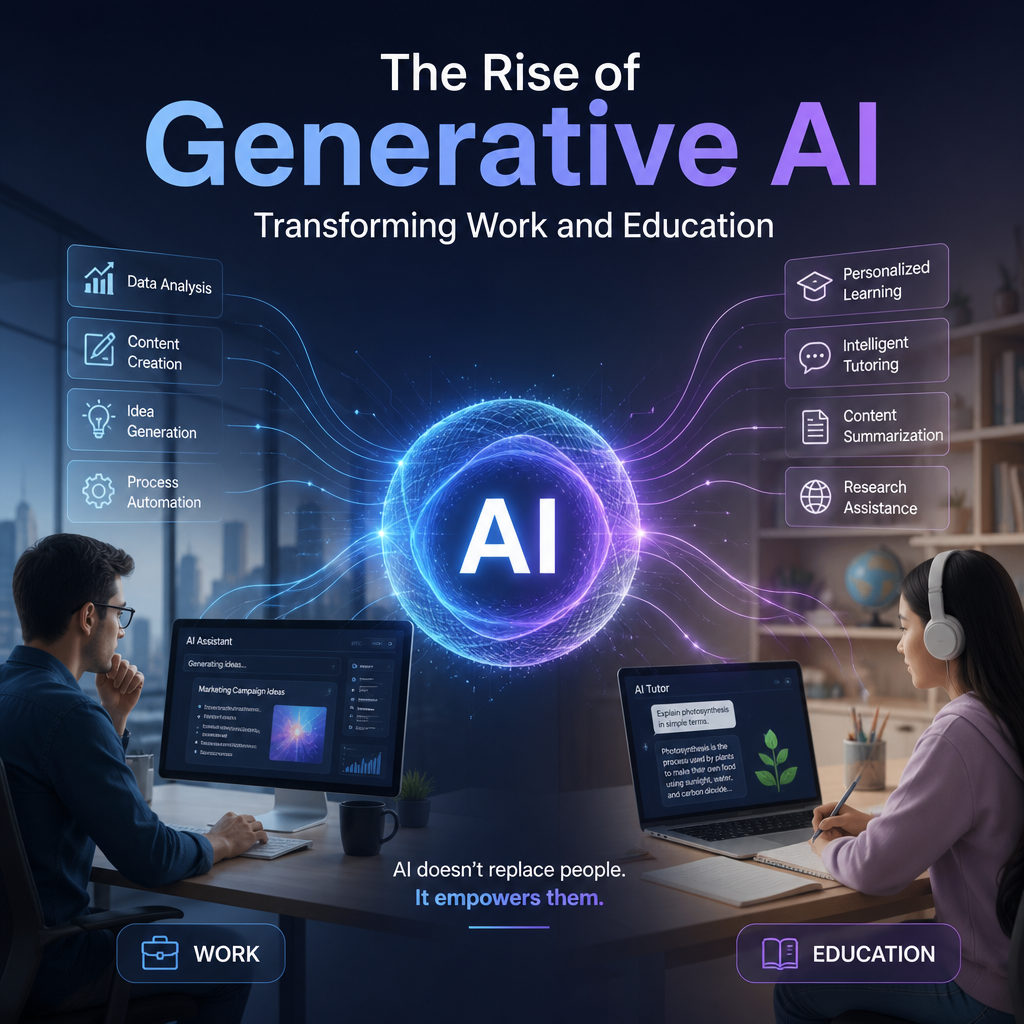
The Rise of Generative AI: Transforming Work and Education
Generative AI is quickly changing the way people work and learn, from drafting content and analyzing data to creating personalized lessons and support. As this technology becomes more common, understanding its strengths and limits is essential for using it effectively and responsibly.
By: Peter on July 30, 2026
Generative AI is no longer a futuristic idea reserved for research labs and tech conferences. It is already reshaping how people write, design, analyze, teach, learn, and solve problems. From drafting emails and building lesson plans to supporting customer service and speeding up research, generative AI is becoming a practical tool in everyday work and education.
As adoption grows, so does the need to understand what this technology can do well, where it can fail, and how people can use it responsibly. The real story of generative AI is not just about automation. It is about augmenting human effort, changing expectations, and creating new opportunities for productivity and creativity.
What Is Generative AI?
Generative AI refers to artificial intelligence systems that create new content based on patterns learned from data. Instead of simply classifying information or making predictions, these tools generate text, images, audio, video, code, and other outputs.
Common examples include:
Chatbots that draft responses or summarize documents
Image tools that create visuals from written prompts
Code assistants that suggest functions or fix bugs
Learning tools that personalize explanations or practice questions
Unlike traditional software, generative AI responds flexibly to prompts. That makes it useful in many settings, but it also means results can vary in accuracy, tone, and usefulness.
How Generative AI Works in Simple Terms
At a high level, generative AI models learn from large datasets and identify patterns in language, images, or code. When given a prompt, they predict the most likely output based on that training.
That is why these tools can sound confident even when they are wrong. They do not “know” facts the way humans do. They generate responses based on probabilities. Understanding that limitation is essential for using generative AI wisely at work and in education.
How Generative AI Is Transforming Work
Businesses are adopting generative AI because it can speed up routine tasks, support creative work, and help teams do more with limited time. But the value is not just in saving minutes. It is also in improving how people think through problems and communicate ideas.
Generative AI in the Workplace
1. Faster Writing and Communication
One of the most immediate uses of generative AI is drafting content. Professionals use it to create:
Emails and internal memos
Reports and summaries
Marketing copy and product descriptions
Meeting agendas and follow-up notes
For example, a project manager can ask a generative AI tool to turn meeting notes into a polished update for stakeholders. A sales team member can use it to draft a personalized outreach message, then refine it for tone and accuracy.
This does not replace human judgment. It reduces the time spent on first drafts so employees can focus on higher-value work.
2. Smarter Research and Knowledge Work
Generative AI can help workers sift through large amounts of information faster. It can summarize long documents, compare ideas, and suggest next steps. In fields like law, healthcare, finance, and consulting, that support can be valuable when paired with expert review.
A consultant might use generative AI to summarize interview notes. A manager might use it to turn customer feedback into themes. In both cases, the tool accelerates analysis, but humans still need to verify conclusions.
3. Support for Coding and Technical Tasks
Developers increasingly use generative AI to write boilerplate code, explain functions, and identify errors. This can improve speed and reduce repetitive work.
However, code generated by AI still needs testing. It may contain bugs, security issues, or inefficient logic. Skilled developers use it as a collaborator, not a substitute for careful review.
4. Creative Brainstorming and Design
Generative AI is also changing how teams approach ideation. Designers, marketers, and product teams use it to explore concepts more quickly. A small business owner might generate logo concepts, campaign slogans, or website copy before choosing a direction.
This can be especially helpful for small teams that need creative output without a large production budget. Still, originality, brand consistency, and ethical use should remain priorities.
5. Workflow Automation and Productivity Gains
Generative AI often sits inside broader productivity systems. It can help summarize meetings, draft task lists, route support requests, or generate responses for common questions.
Used well, it frees people from repetitive work. Used poorly, it can create more noise, lower quality, or overreliance on automation. The best results come when organizations pair AI tools with clear processes and human oversight.
How Generative AI Is Reshaping Education
Education is another area experiencing major change. Generative AI can support teachers, expand access to learning, and help students work more independently. At the same time, it raises questions about academic integrity, critical thinking, and fairness.
Generative AI in Education
1. Personalized Learning Support
Every student learns at a different pace. Generative AI can help by explaining concepts in multiple ways, generating practice questions, or adapting examples to a learner’s level.
For instance, a student struggling with algebra can ask for a simpler explanation and a step-by-step walkthrough. Another student can request more challenging problems or a different learning style, such as a visual analogy or a real-world example.
This kind of support can make learning feel more accessible and less intimidating.
2. Assistance for Teachers
Teachers face heavy workloads. Generative AI can help them draft lesson plans, create quizzes, suggest discussion prompts, and write parent communications. It can also help adapt materials for different reading levels or language needs.
A teacher might use generative AI to build a first draft of a lesson on climate change, then revise it to fit classroom goals and student needs. That can save time while preserving educator expertise.
3. Writing and Revision Help for Students
Generative AI can act like a writing coach when used appropriately. It can help students brainstorm ideas, organize outlines, improve clarity, or check grammar.
That said, the line between support and academic dishonesty matters. If a student submits AI-generated work as their own, the learning process breaks down. Schools and instructors are increasingly focusing on acceptable use policies that encourage transparency and skill-building.
4. Accessibility and Inclusion
Generative AI can improve access for students with disabilities or language barriers. It may help simplify text, generate summaries, or support translation and speech-based interaction.
For students who need more time or alternative formats, these tools can reduce friction and create more equitable learning experiences. Accessibility, however, depends on careful implementation and human oversight.
5. New Skills for a Changing Job Market
As generative AI spreads, students need more than technical familiarity. They need to learn how to ask good questions, judge output quality, fact-check claims, and use tools responsibly.
That means education is shifting from memorizing information to developing judgment, creativity, and adaptability. These are skills that remain valuable even as technology changes.
Risks and Limitations to Watch
Generative AI is powerful, but it is far from perfect. Understanding its limits is just as important as recognizing its benefits.
Accuracy Problems
Generative AI can produce incorrect, outdated, or misleading information. It may also invent details that sound plausible. This is especially risky in academic, legal, medical, and business contexts where precision matters.
Bias and Fairness Concerns
AI systems can reflect patterns and biases present in their training data. That can lead to unfair, incomplete, or stereotyped outputs. Responsible use requires evaluation, testing, and a willingness to question results.
Privacy and Security Issues
Users should avoid entering sensitive personal, financial, or confidential data into tools that are not approved for that purpose. Organizations also need policies for data handling, retention, and access.
Overdependence
If people rely too heavily on generative AI, they may weaken their own writing, research, or problem-solving skills. The best approach is to use AI as a support tool, not a replacement for thinking.
Practical Ways to Use Generative AI Responsibly
Whether you are a manager, teacher, student, or employee, good habits make a big difference.
Best Practices for Work
Use AI for drafts, not final decisions.
Verify facts, names, and numbers before sharing content.
Keep a human in the loop for quality control.
Follow company policies on data privacy and confidentiality.
Use clear prompts to improve output quality.
Best Practices for Education
Check your school’s AI policy before using a tool.
Use AI to support learning, not replace it.
Cite or disclose AI assistance when required.
Compare AI explanations with textbooks, class notes, or trusted sources.
Treat generated content as a starting point, then revise it yourself.
A Simple Example of Good Use
Imagine a student writing a history essay. Generative AI can help brainstorm a thesis statement, suggest an outline, or explain a difficult concept. The student then researches the topic, writes the paper in their own words, and checks all sources.
That approach uses AI as a learning aid, not a shortcut.
What Businesses and Schools Should Do Next
Organizations do not need to adopt generative AI everywhere at once. A thoughtful rollout works better.
For Employers
Start with low-risk use cases such as drafting and summarization
Train employees on strengths, limitations, and responsible use
Create review steps for AI-generated output
Define acceptable and restricted uses
Revisit policies as the technology evolves
For Educators
Establish clear classroom rules around AI use
Teach students how to evaluate AI-generated content
Design assignments that reward critical thinking and originality
Use AI to reduce administrative burden where appropriate
Emphasize transparency and academic integrity
The goal is not to ban generative AI or embrace it blindly. The goal is to use it intentionally.
The Future of Generative AI in Work and Education
Generative AI will likely become more embedded in the tools people already use. Word processors, learning platforms, search systems, and collaboration apps are all adding AI features. That means the technology will feel less like a separate invention and more like part of daily workflows.
As that happens, the most valuable people and organizations will be those that combine technical fluency with strong human judgment. Critical thinking, creativity, communication, and ethics will matter even more.
Generative AI may change how work gets done and how students learn, but it will not eliminate the need for expertise, context, or responsibility. Instead, it raises the standard for how people use information and create value.
Frequently Asked Questions
1. What is generative AI in simple terms?
Generative AI is a type of artificial intelligence that creates new content, such as text, images, code, or audio, based on patterns it learned from data. It responds to prompts and generates outputs that resemble human-created work.
2. How is generative AI being used at work?
People use generative AI for drafting emails, summarizing documents, brainstorming ideas, writing code, creating marketing content, and automating routine tasks. It can improve productivity, but outputs should always be reviewed by humans.
3. How can generative AI help students learn?
Generative AI can explain concepts in different ways, generate practice questions, help with outlining and revision, and support accessibility needs. When used responsibly, it can make learning more personalized and efficient.
4. What are the biggest risks of generative AI?
The main risks include inaccurate information, bias, privacy issues, and overreliance. In sensitive contexts, users should verify everything and avoid sharing confidential data with unauthorized tools.
5. Should schools and companies create AI policies?
Yes. Clear policies help people understand what is allowed, what needs disclosure, and how to protect privacy and quality. Good policies encourage responsible use while making space for innovation.
The rise of generative AI is changing the way people work and learn, but its real impact depends on how thoughtfully it is used. In the workplace, it can streamline communication, support research, and speed up repetitive tasks. In education, it can personalize learning, assist teachers, and expand access. Yet the same technology also brings clear challenges, including misinformation, bias, privacy risks, and the temptation to overdepend on automation.
The most effective approach is balanced and practical. Use generative AI to save time, explore ideas, and improve productivity, but keep human judgment at the center. Check facts, protect sensitive data, and be transparent about when and how AI is used. For students and professionals alike, the goal is not simply to keep up with technology. It is to learn how to use it well.
As generative AI continues to evolve, the people who benefit most will be those who combine curiosity with critical thinking. Start by experimenting with one useful task, then build better habits around accuracy, ethics, and creativity. That is how generative AI becomes a meaningful advantage rather than just a passing trend.
Peter B holds a degree in Journalism and has 5 years of experience covering U.S. economic policy, labor markets, and financial news. He writes data-driven news content on topics like inflation, interest rates, and employment trends.