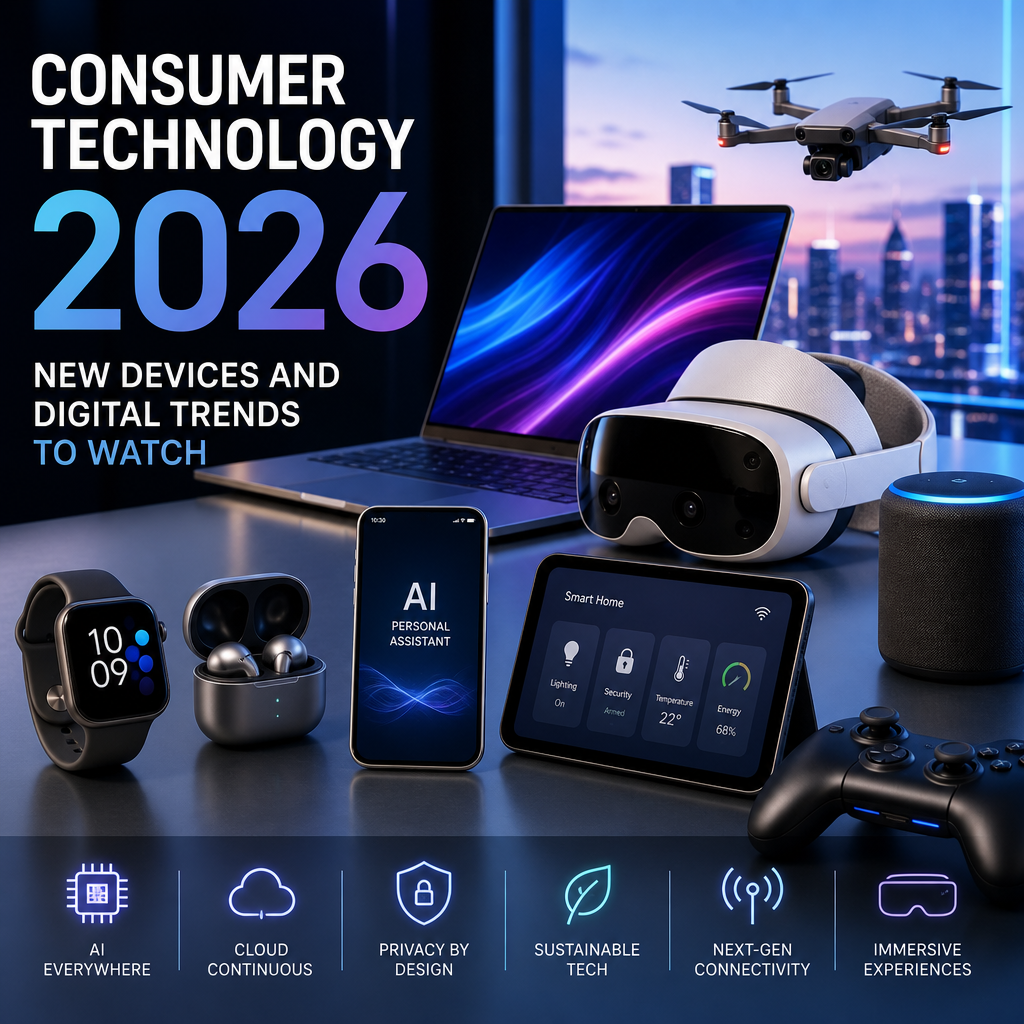
Consumer Technology 2026: New Devices and Digital Trends to Watch
Consumer technology 2026 is bringing smarter devices, more intuitive wearables, and AI tools that feel genuinely helpful in everyday life. This year’s biggest trends focus on practical upgrades like better privacy, longer battery life, and smoother connections across all your favorite devices.
By: Peter on July 30, 2026
Consumer technology 2026 is shaping up to be one of the most interesting years yet for everyday users. From smarter personal devices and more capable wearables to AI-powered software that feels less like a feature and more like a companion, the pace of change is accelerating. The biggest shift is not just that devices are getting faster or thinner—it’s that they are becoming more adaptive, more connected, and more useful in daily life.
If you’ve been waiting to see where the next wave of consumer tech is headed, this year offers plenty to watch. The most important developments are centered on practical value: better battery life, stronger privacy controls, more natural voice interfaces, and devices that work together more seamlessly across home, work, and travel.
Consumer Technology 2026 at a Glance
The consumer technology 2026 landscape is being shaped by a few major themes:
AI built directly into devices instead of relying only on cloud services
Wearables that track more than fitness, including stress, sleep, and recovery
Smarter home ecosystems that reduce manual setup and automation friction
Faster, more efficient mobile chips that improve battery life and performance
Expanded mixed reality tools for work, entertainment, and communication
Growing demand for privacy, security, and transparent data practices
In other words, the best products this year won’t simply look futuristic. They’ll solve real problems more gracefully than older tech.
AI-Powered Devices Are Becoming More Useful
Artificial intelligence has moved from a buzzword to a core part of consumer technology 2026. The difference this year is that AI is becoming more personal and more local. Many devices now run certain AI tasks on-device, which can make interactions faster and more private.
What this means for everyday users
AI-powered features are showing up in places people use constantly:
Phones that summarize notifications, emails, and long messages
Laptops that generate notes, transcribe meetings, or improve search
Smart speakers that understand more natural requests
Cameras and editing apps that clean up images and video clips automatically
Instead of requiring users to learn new workflows, the best AI features are blending into familiar apps and devices.
Why on-device AI matters
On-device AI reduces dependence on constant internet access and can improve privacy because sensitive data does not always need to travel to the cloud. That matters for tasks like:
Voice recognition
Photo classification
Personal reminders
Health data analysis
Real-time translation
For many consumers, this may become the biggest reason to upgrade hardware in 2026.
Smartphones Are Evolving Beyond Specs
Smartphones remain the center of most digital lives, but consumer technology 2026 is pushing them in a more thoughtful direction. Rather than competing only on camera counts or benchmark scores, manufacturers are focusing on practical improvements.
Expect better battery efficiency
Battery life continues to be one of the most important buying factors. New chip designs and software optimization are helping phones stretch usage without adding bulk. That means more people can expect all-day performance even with heavy streaming, navigation, and app use.
Cameras are getting smarter, not just sharper
Phone cameras are increasingly using software to improve real-world results. Key trends include:
Better low-light performance
Cleaner zoom images
More natural skin tones
Smarter portrait and motion capture
Faster editing tools built into the gallery app
The emphasis is shifting from raw megapixels to how well a phone can capture a moment with minimal effort.
Foldables and compact premium phones stay relevant
Foldable phones are no longer novelty devices. While still expensive, they are becoming more refined, with stronger hinges, better outer screens, and improved durability. At the same time, some users still want smaller, lighter phones that fit easily in a pocket. Both categories are likely to remain important in 2026.
Wearables Are Moving Into Health and Context Awareness
Wearables have come a long way from basic step counters. In consumer technology 2026, they are increasingly focused on understanding context: how you sleep, how stressed you may be, when you should recover, and how your habits affect your overall routine.
Smartwatches are becoming more proactive
Modern smartwatches can already handle notifications, workouts, and heart-rate tracking. This year, many models are adding more advanced health insights and better integration with phones and apps.
Common wearable trends include:
More accurate sleep tracking
Recovery and stress indicators
Smarter exercise recommendations
Improved menstrual and cycle tracking
Fall detection and emergency assistance
Better long-term trend analysis
Smart rings and lightweight wearables are gaining attention
Not everyone wants a watch on their wrist all day. Smart rings and other lightweight wearables are attracting users who want health tracking without a large screen. These devices often appeal to people who value comfort, minimal design, and longer battery life.
Fitness tech is becoming more personalized
Instead of pushing generic goals, newer wearables are using data to personalize suggestions. That may include recommending rest after poor sleep, adjusting workout intensity, or identifying patterns that affect energy levels.
For consumers, the best value comes from devices that help them make better decisions without overwhelming them with charts.
Smart Homes Are Getting Easier to Use
The smart home category has existed for years, but consumer technology 2026 is making it more approachable. The biggest issue in the past was complexity: too many apps, confusing setups, and devices that didn’t always communicate well.
Interoperability is improving
A major trend is better compatibility among smart home devices. More products now support shared standards that make it easier to connect lights, locks, thermostats, and speakers across different brands.
That matters because users want:
Fewer apps to manage
Faster setup
More reliable automation
Consistent voice assistant support
Better control from one dashboard
Home automation is becoming more practical
Instead of flashy routines that feel gimmicky, consumers are using automation for routine tasks such as:
Turning lights on at sunset
Adjusting temperature when the home is empty
Locking doors at night
Running appliances on schedule
Sending alerts when motion is detected
These features save time and reduce friction, which is exactly why smart home adoption keeps growing.
Energy awareness is a priority
With rising interest in sustainability and household efficiency, smart home tools that monitor energy use are becoming more attractive. Smart plugs, thermostats, and appliances can help people better understand consumption patterns and reduce waste.
Mixed Reality Is Finding Real Use Cases
Virtual and augmented reality have often been discussed in futuristic terms, but consumer technology 2026 is bringing more grounded use cases. Mixed reality headsets and glasses are starting to find practical appeal in entertainment, collaboration, education, and design.
Entertainment remains a major driver
For many users, immersive video and gaming remain the most compelling reasons to try mixed reality. Better displays, lighter designs, and more intuitive interfaces are making these products less awkward and more enjoyable.
Productivity tools are getting stronger
Some headsets are now being used for:
Multi-monitor virtual workspaces
Remote collaboration
3D design visualization
Training simulations
Virtual meetings with spatial context
These use cases are still developing, but they point toward a future where headsets are not just novelty gadgets.
Comfort and wearability still matter
For mixed reality to become mainstream, devices need to be lighter, less bulky, and easier to wear for longer periods. Battery life, heat management, and display clarity remain key challenges, but progress is steady.
Privacy and Security Are Mainstream Buying Factors
Consumers are more aware than ever that connected devices collect data. In consumer technology 2026, privacy and security are no longer niche concerns—they are central features users actively evaluate before buying.
What consumers are looking for
People want devices that offer:
Clear privacy settings
Local processing when possible
Encryption and secure updates
Transparent data policies
Easy account and permission management
Why this trend matters
A product can be innovative and still fail if it creates trust issues. Consumers are increasingly choosing brands that explain what data is collected, how it is stored, and how it can be deleted.
This is especially important for:
Cameras
Smart speakers
Wearables
Home security devices
Children’s devices and family tech
Security updates also matter more than ever because connected devices often stay in homes for years. If a company stops supporting a product too quickly, consumers notice.
PCs and Laptops Are Becoming More Efficient
The personal computer market continues to evolve in consumer technology 2026, especially as more users rely on laptops for hybrid work, school, content creation, and casual entertainment.
Thin devices with better performance
Modern laptops are emphasizing:
Longer battery life
Quiet operation
Improved AI acceleration
Better built-in microphones and cameras
Faster wake times and smoother multitasking
This combination is especially useful for students, remote workers, and creators who need a reliable machine that can travel easily.
Creators want versatility
Photo editors, video creators, and streamers are looking for laptops that balance performance and portability. That includes devices with:
High-quality displays
Strong GPU support
Fast storage
Good thermal management
Useful ports without excessive dongles
Desktop PCs still matter
Even as laptops dominate everyday use, desktops remain important for gaming, production work, and advanced multitasking. Consumers who want upgradeability and longevity continue to see value in desktop systems.
Digital Services Are More Integrated Into Daily Life
Another major part of consumer technology 2026 is how software platforms are becoming more integrated across devices. People do not just buy hardware anymore—they buy into ecosystems.
Subscription fatigue is pushing smarter choices
Consumers are becoming selective about subscriptions for cloud storage, media, productivity, and security. Many want bundled services that provide clear value without unnecessary overlap.
Cross-device continuity is a competitive advantage
Features that let users move easily between phone, tablet, laptop, and TV are becoming more important. Examples include:
Shared clipboard tools
Instant file sync
Universal messaging
Seamless media casting
Shared app state across devices
When these features work well, they save time and reduce frustration.
Practical Tips for Choosing Consumer Tech in 2026
With so many choices, it helps to focus on long-term usability rather than marketing hype. Before buying a new device, ask:
Does it solve a real problem in my daily routine?
Will it receive software updates for several years?
Does it support privacy and security features I trust?
Is the battery life realistic for how I use devices?
Will it work well with the products I already own?
A thoughtful purchase often beats a trend-driven one, especially when devices are meant to last.
Frequently Asked Questions
1. What is the biggest trend in consumer technology 2026?
The biggest trend is the rise of AI-powered devices that are more useful, personal, and privacy-conscious. Instead of acting as separate add-ons, AI features are being built directly into phones, laptops, wearables, and smart home products.
2. Are smart home devices easier to use in 2026?
Yes, many smart home devices are becoming easier to set up and manage. Better interoperability standards and simpler app controls are reducing friction, making it more practical for consumers to automate lighting, climate control, security, and other everyday tasks.
3. Are wearables still mainly for fitness tracking?
Not anymore. Wearables in 2026 are increasingly focused on overall wellness, including sleep, recovery, stress, and long-term health trends. Many users now rely on them for more than step counts or workout tracking.
4. Is mixed reality worth paying attention to this year?
Yes, especially if you are interested in immersive entertainment, virtual workspaces, design tools, or collaborative experiences. While mixed reality still faces comfort and cost challenges, the technology is becoming more practical and easier to use.
5. How can I tell if a new tech product is worth buying?
Look for products that solve a real problem, offer reliable updates, support your privacy preferences, and work well with your existing devices. A good consumer tech purchase should improve daily life, not just add another screen or app.
Consumer technology 2026 is less about flashy gimmicks and more about meaningful improvement. The most important devices this year are the ones that fit smoothly into daily life, whether that means a phone with smarter AI tools, a wearable that helps you understand your health, a smart home system that finally works together, or a laptop that lasts all day without slowing you down.
As you explore new products, focus on practical benefits: battery life, privacy, software support, ease of use, and ecosystem compatibility. Those qualities matter far more than trend-driven marketing claims. The best tech should feel helpful, reliable, and easy to trust.
If you are planning an upgrade this year, take a closer look at how each device will work over time, not just how it looks on launch day. That approach will help you choose consumer technology that delivers real value now and stays useful well beyond 2026.
Peter B holds a degree in Journalism and has 5 years of experience covering U.S. economic policy, labor markets, and financial news. He writes data-driven news content on topics like inflation, interest rates, and employment trends.